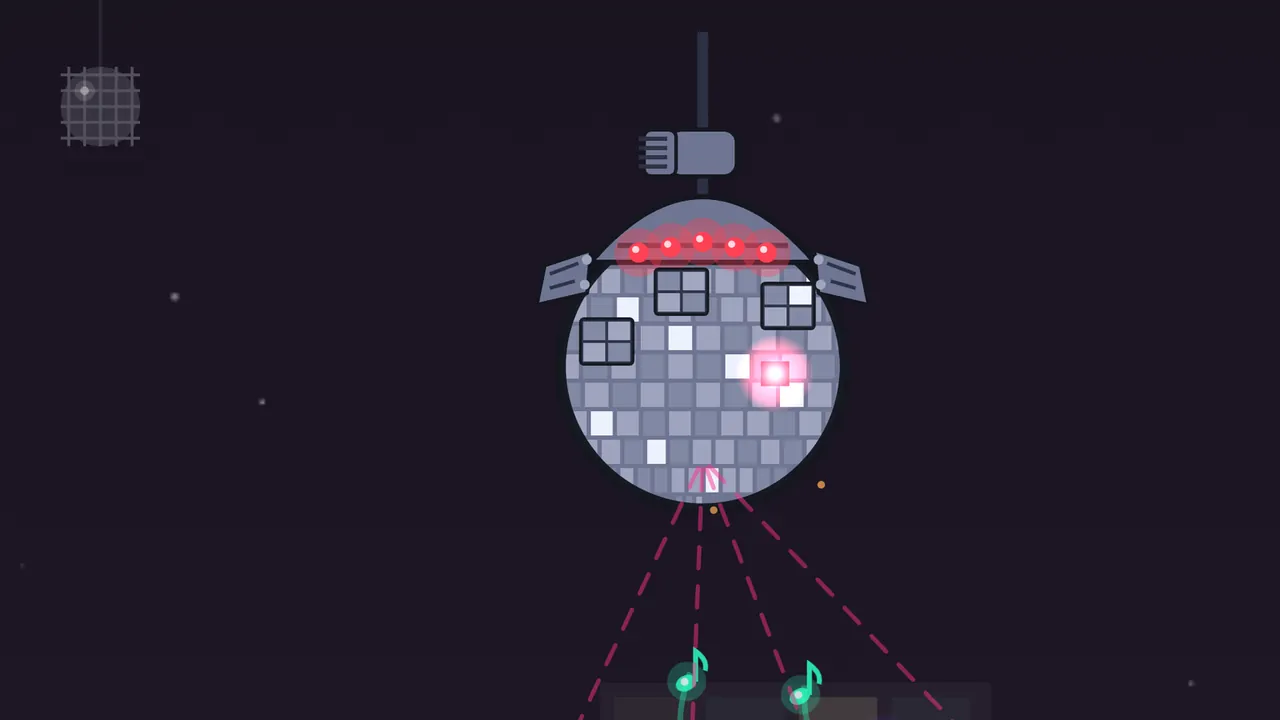
Turbo Pudding
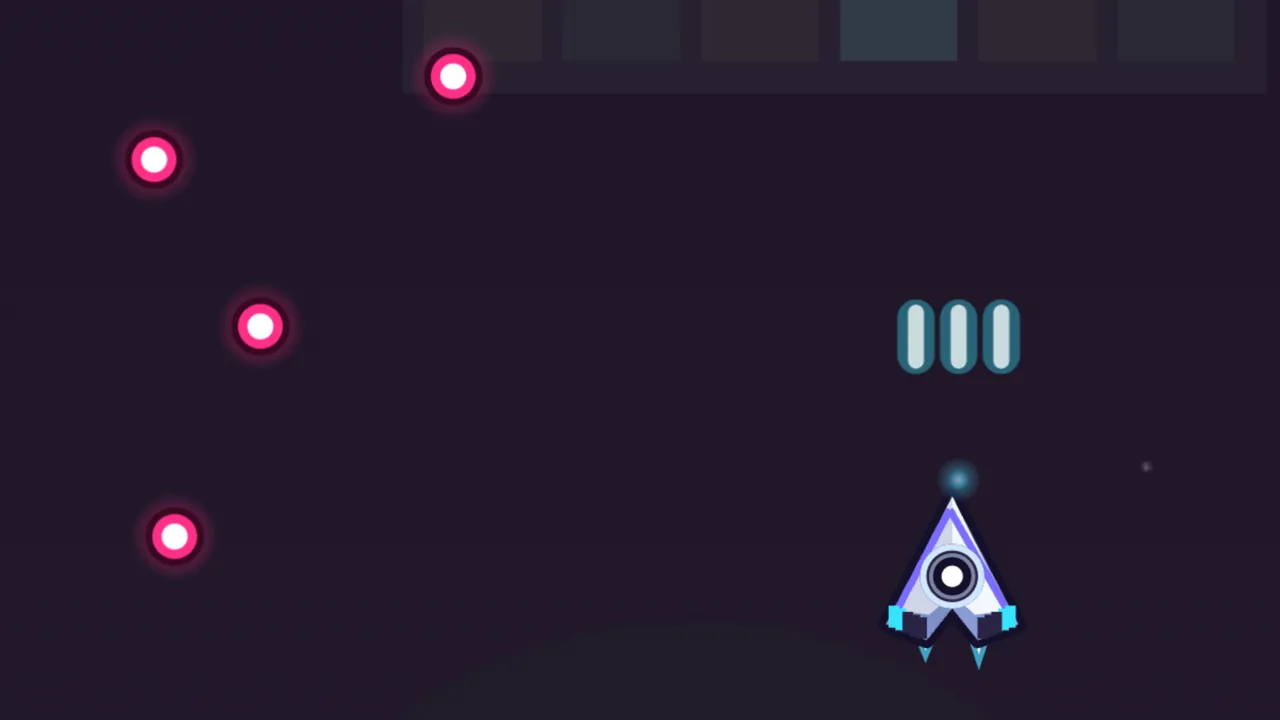
Loudnik has no painted sprites. Every ship, Jammer, bullet and planet is drawn by the game’s own code, out of circles, lines and a short list of colors. That list was settled on paper first, and one rule shaped it more than any other: whatever happens on screen, you must always see the bullets. It’s Sunday, so let’s open the sketchbook.
Three ships on paper
Volta’s ship went through three drafts. The first was a guitar: a long, narrow fretboard for a nose, four glowing strings and a round sound hole for an engine. It looked great, but its tall shape hid the bullets right above it, and its center, the spot that matters most, was hard to read. The second was a cassette, with two spinning spools for engines. Very cute, but it never looked fast, and a flat, even brick barely shows when it banks.
The winner was the one we called the Speaker: an arrowhead with a loudspeaker cone in the middle. An arrow reads as “fast” even at thirty pixels. The cone gives the ship a natural center, and its white dust cap is exactly where a bullet can hit you. The cone pumps on the beat, and five little equalizer bars on each wing show your weapon level, so there is no extra gauge. The cassette made it into the game after all, as Bobina, Volta’s robot.
Color means something
Next came the palette, and every color got a job. Volta’s side is cool and bright, with teal, lime, blue, mint and silver shots. Monotone’s army is matte gray. Each Jammer has one red “rec” light that blinks once a second and swells just before it fires, so the warning is built into the enemy. Shape tells you the rest: sharp ones are fast, round ones spin and fire rings, blocks are armor, and gold trim means the Jammer is carrying loot.

Two colors belong to the enemy alone: crimson for small aimed bullets and violet for big, slow orbs. Nothing else in the game may use them, not your shots, not your bombs, not the pickups. That’s why the extra life is a coral heart, not a pink one, and why the Scratch bomb got a silver label after a lilac one sat too close to the violet orbs. Even the confetti that bursts out of a beaten Jammer comes in the station’s own colors, and no station has crimson in it. On the Disco Rings, the planet of the endless party, it’s teal, gold and orange.
Anatomy of a bullet
Every enemy bullet is built the same way, from the outside in: a faint halo, a dark rim, the colored body and a big white core, more than half its width. The rim looks like a detail, but everything depends on it. We checked the colors with the same contrast math used for text on websites. In brightness, crimson against a gray Jammer hull is only 1.3 to 1, so a bullet flying past a Jammer would simply melt into it. The dark rim against the hull is 3.6 to 1, and the bullet stays a bullet.
Some bosses fire mirror shards, pixels or scraps of felt instead of round dots. The shape can change from station to station. The color never does.
Dark skies, thin neon
The backgrounds have rules too, and they all say one thing: bullets must always win. Skies stay dark and muted, neon shows up only as thin lines and dots, and the pulse of the beat may change the middle layer by no more than eight percent. On top of that, a bullet has to stand out from its sky by at least 3.5 to 1.
Bell Garden, an airy world of glass bells, had the lightest sky in the game, and the violet orbs failed there at 3.1 to 1. So we darkened the sky to a deeper teal and kept the bells.
The black-and-white test
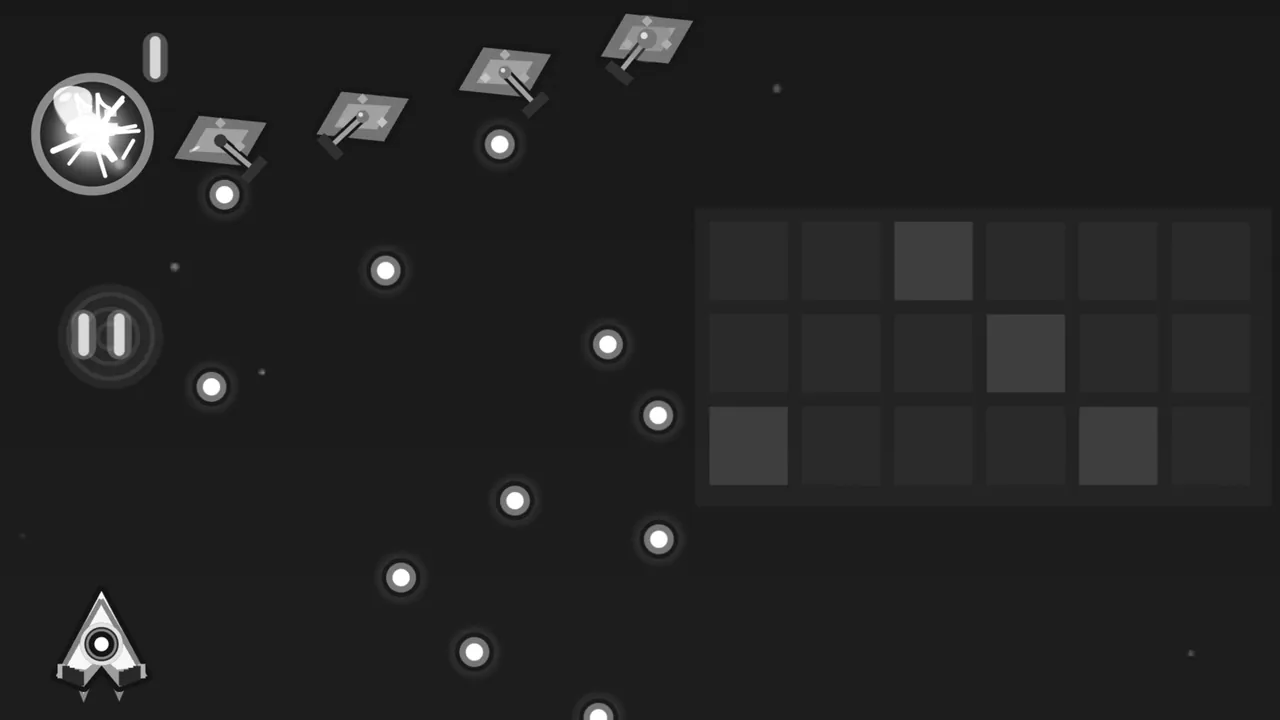
Brightness matters more than hue. In a shooter, you don’t stare at your ship. You follow the stream of your own shots and catch everything else out of the corner of your eye, where a light core next to a dark rim shows up long before any color does.
So every level has to pass one test: take a screenshot and drain the color out. If the rules work, every enemy bullet is still a white dot in a dark ring, while the sky turns flat dark gray behind it.
High-contrast bullets
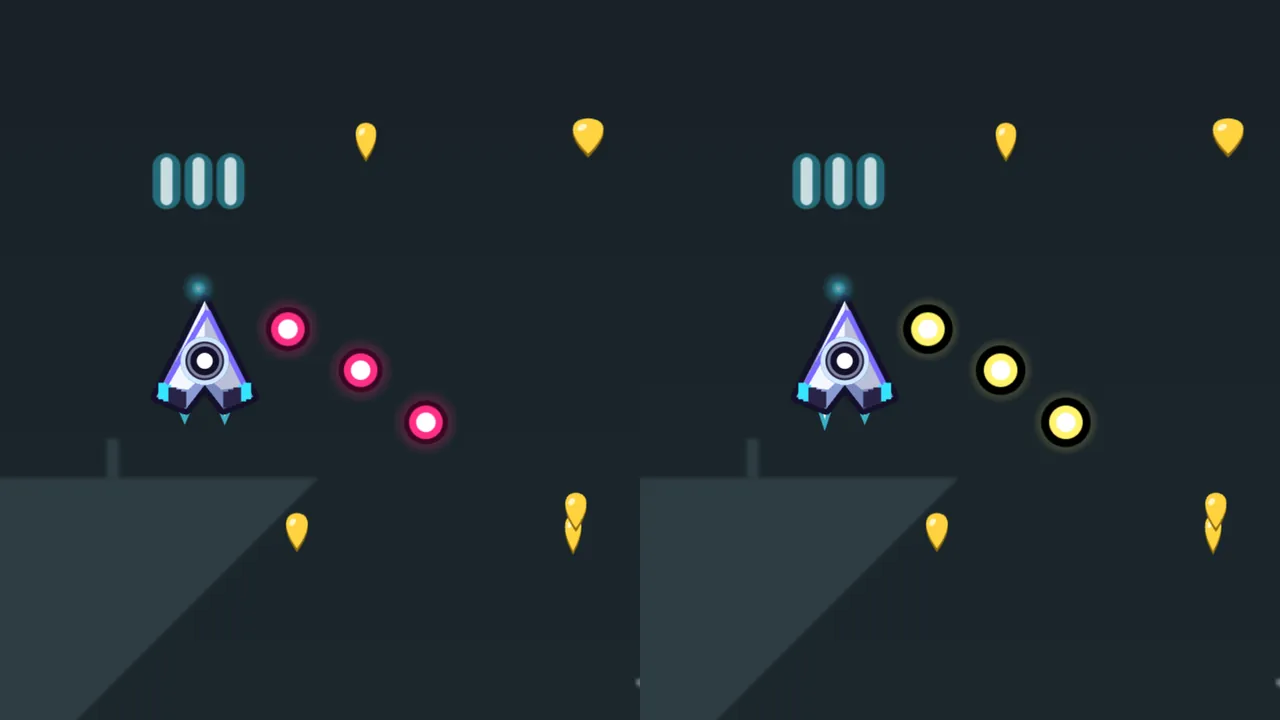
Crimson on a dark sky isn’t easy for everyone to see. So under Accessibility in the settings there is a switch called High-contrast bullets. It turns every enemy bullet yellow-white with a thick black rim and changes nothing else about the fight. Next to it is Darker background, which lays a dark veil over the sky.
You never see these rules while you play. You just never lose a bullet.
Tune in
The first three stations are free to play in your browser at loudnik.com. The full game, all ten stations, is $4.99, paid once. More about the game is on the Loudnik page.