Turbo Pudding
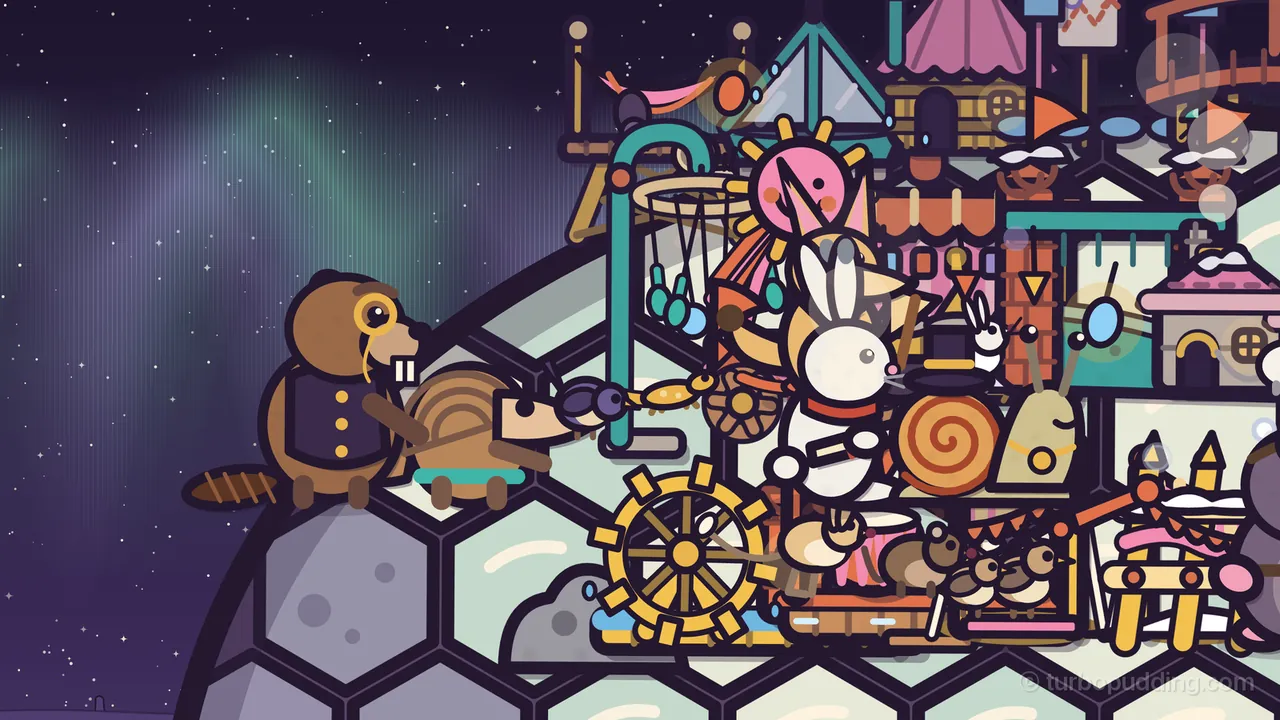
It’s Wednesday, so here’s a page from the dev diary, and this one is about sound. Amblestead has no recordings in it at all: no samples, no instruments played into a microphone, no voices. Every tok, bell, hum and footstep is built in your browser from plain tones and soft puffs of noise, at the moment it plays.
The picture at the top is the Wind Chimes on Aurora Plain, where the town has a word or two to say about music. More about that at the end.
Six materials, six voices
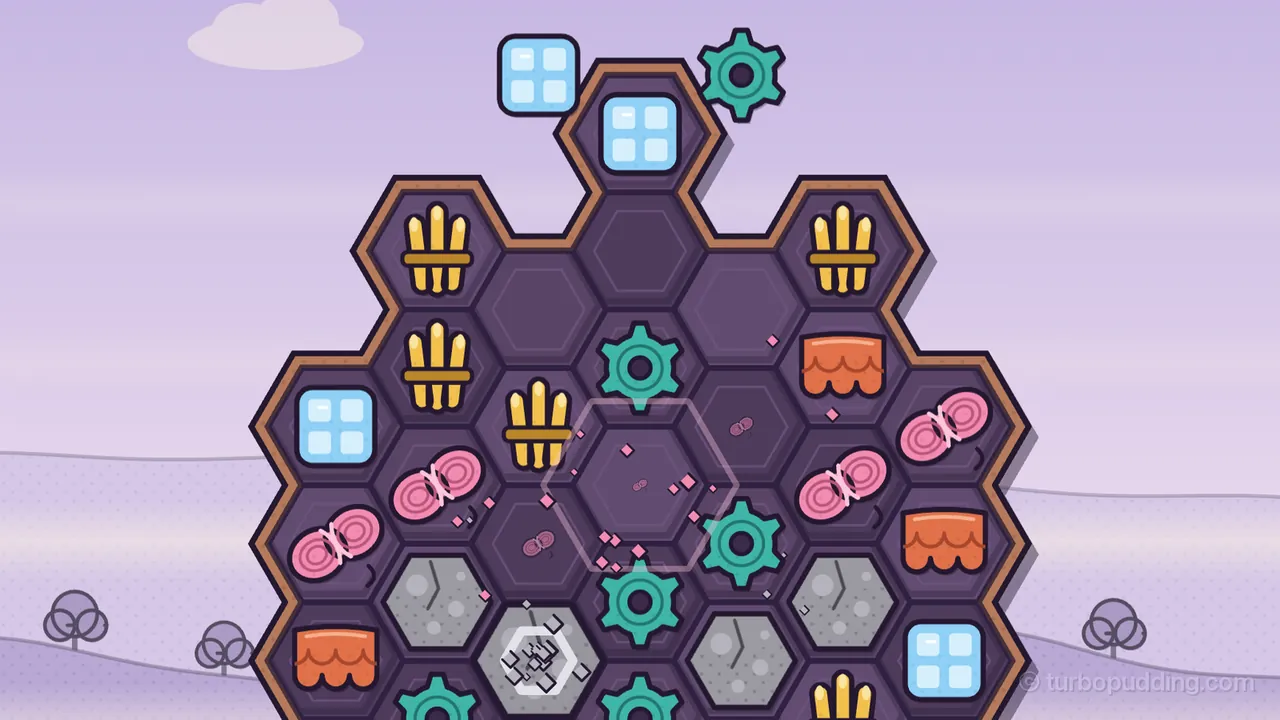
The pieces on the board are building materials, and each one has its own sound. Clay tiles knock like a wood block. Reed bundles make a breathy pluck. Wool skeins sound like a felt mallet. Copper cogs ring like a small bell, glass panes give a clear high ting, and slate answers with a low wooden tock.
They sit at different heights, too. Copper and glass sing highest, clay and reed in the middle, and wool and slate down low. So with your eyes shut, you could still guess which material you just cleared.
A cascade climbs a scale
When you clear a line, you hear its material play a note from the chapter’s scale. Every scale in the game has only five notes, picked so that no two of them clash. That way, whatever lands at the same moment still sounds like music.
Each wave of a cascade plays one step higher than the wave before it, up to nine steps, and then it holds. A long cascade sounds like a little run up a staircase. When two separate matches go off in the same wave, the second plays two steps above the first, which makes a small chord, and a single wave plays three notes at most.
Every chapter has its own scale. Mist Valley is bright and open. Red Canyon goes minor, for dusk among the rocks. Snow Pass uses an old folk scale, and the Glass Desert hangs between major and minor without settling on either.
Big moments, kept gentle
The Keystone has one firm rule: it is never a blast. A stone dropping into an arch could easily sound like an explosion, and we wanted none of that. So the Keystone makes two dry clacks of stone, a short thunk as it sits into its seat, and a little grit trickling from the joints, with nothing in the deep bass.
A win plays a rising run of six notes, then Amabel’s footstep and a soft chord. If daylight runs out before the work is done, there’s no buzzer, just four soft notes rolling downward, each one sinking a little as it fades.
A town that plays along
Each chapter has its own tune, an eight-bar loop of a thumb piano melody over a marimba, at a slow walking pace between 72 and 84 beats a minute. Under it, Amabel’s low footstep thumps twice a bar.
The tune grows with the town. Every building you finish in a chapter adds one more part: first a bass line, then a soft held chord, then a second melody, then a shaker and a wood block, up to four. Each chapter also has its own instrument for that second melody: a sliding pluck in Red Canyon, bells in Snow Pass, a pluck like an oud, the round-backed lute, in the Glass Desert, and on Sunrise Shore a soft “choir” built from vowel-like tones, still without a single real voice.
When you play a level, the same tune keeps going, just thinner and quieter, so the notes of the pieces lead. And on the shell, Amabel walks in time. One stride is one bar, and her back feet land on the footstep thumps. If she drifts off the beat, she speeds up or slows down a little until she’s back in step.
Who says what, without words
Nobody in the game has a voice. Instead, every line of dialog plays a short sound of its own. Pim, the carpenter, gets wood blocks. Amabel gets a deep, warm hum. Delva gets a copper bell, Nils a quick pair of glass notes, Saffi a sliding pluck, and Baron Bulwark two knocks on a log. Mayor Barty gets a slow wobble, which suits a snail.
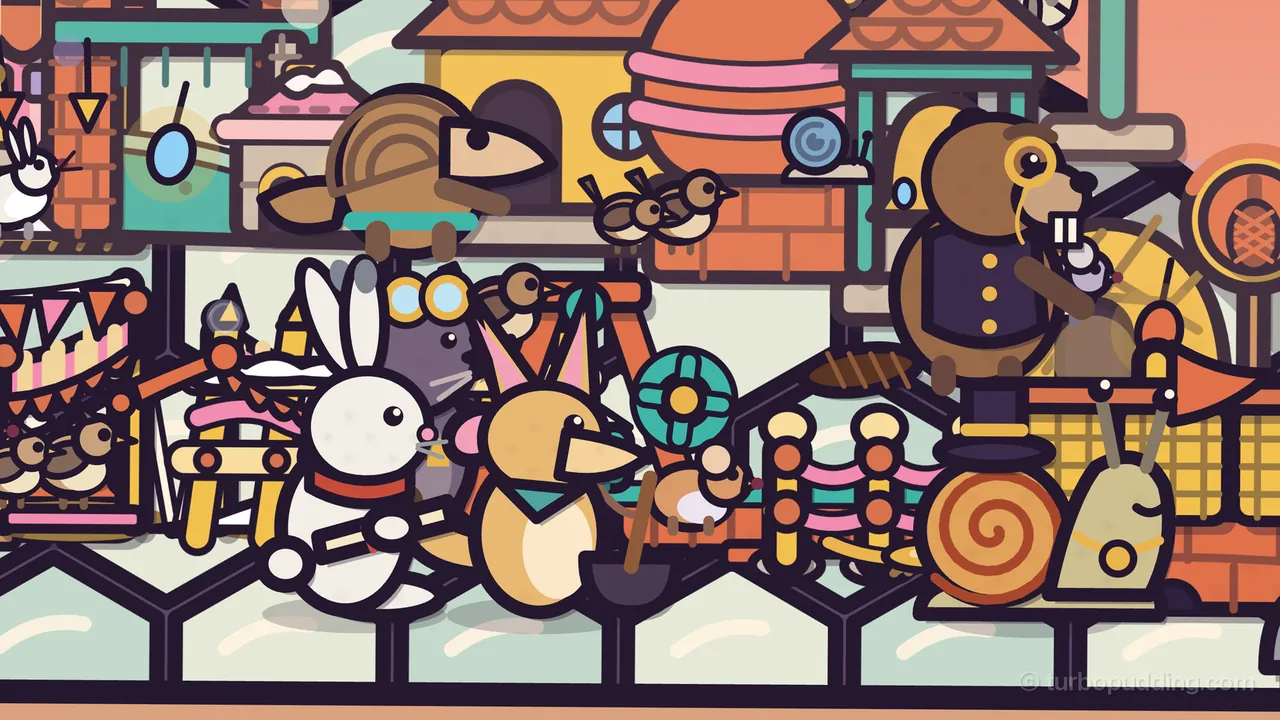
On Sunrise Shore, he announces, “I have prepared a few words.” Nils explains: “He means a few pages.”
Back to the chimes
And the picture at the top? When the Wind Chimes go up on Aurora Plain, Pim says it best: “Listen. Every step she takes plays a note.” Nils approves of the walking music. Baron Bulwark admits that his dams never made music, “Only a great deal of splashing,” and Mayor Barty has the last word: “Splashing is music too. Slow music.”
Nothing makes a sound until your first tap, click or key press. Music and sounds have separate switches and volume sliders, and on an iPhone the silent switch mutes the game, while any music you were already listening to keeps playing.
Mist Valley, the first chapter, is free to play in your browser at amblestead.com. The full game, all six chapters, is $4.99, paid once. More about the game is on its Amblestead page.