Turbo Pudding
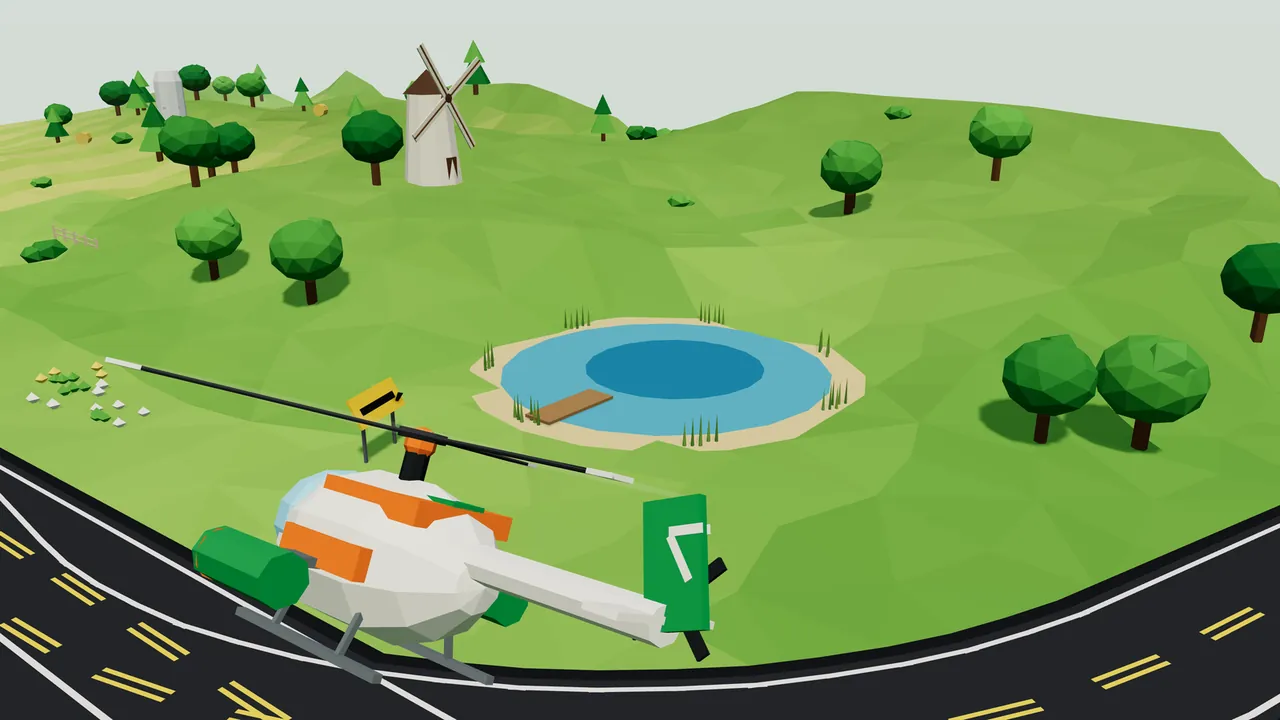
Greenfold Meadows, the first world of Helicorn, looks placed by hand, tree by tree. It isn’t: every level is built from a small kit of land pieces and a box of props. Here is that page from the sketchbook.
Seven pieces of land
The kit has seven pieces: meadow, orchard, creek, road field, quarry, farm and pond. A level is a list of them, each 80 to 200 meters long, laid end to end. Fresh Tarmac, the first level, strings together eight pieces and 1,040 meters of land. The Big Dig, the fourth, has ten pieces and 1,440 meters.
Each piece is a short recipe, not a drawing. It says what the ground does (gentle hills, or sunken pits for the quarry), what colors it wears, and what grows at the sides and how often. A meadow gets patchwork fields beside the corridor, in stripes of dry yellow-green and fresh green. A road field adds patches of bare brown soil and striped barriers.
The game builds the land in 40-meter chunks, a little ahead of you as you fly, and clears them away once they are behind you.
The corridor stays quiet
One rule shapes every piece. Down the middle runs the corridor, a strip 36 meters wide where the fighting happens. Its grass is blended toward one calm green, and only small things may grow there: a patch of flowers, a little bush or a rock, at most five to a chunk. That way the Paver’s machines, their magenta shots and the things you pick up never get lost in the scenery.
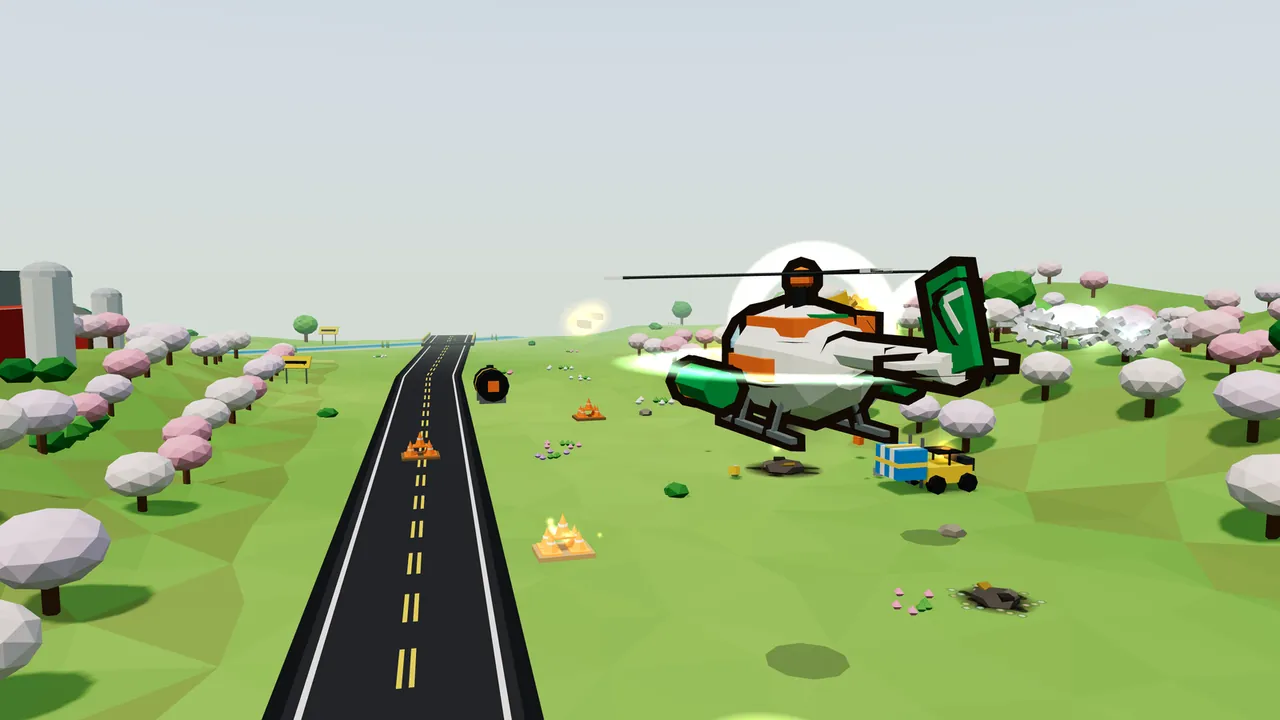
Everything taller waits at the edges, and the orchard shows it best. Its blossom trees stand in rows every 6.5 meters, starting 23 meters out and running up the hills on both sides. About one spot in eight is left empty, so the rows don’t look printed, and the ground between them is striped with soil.
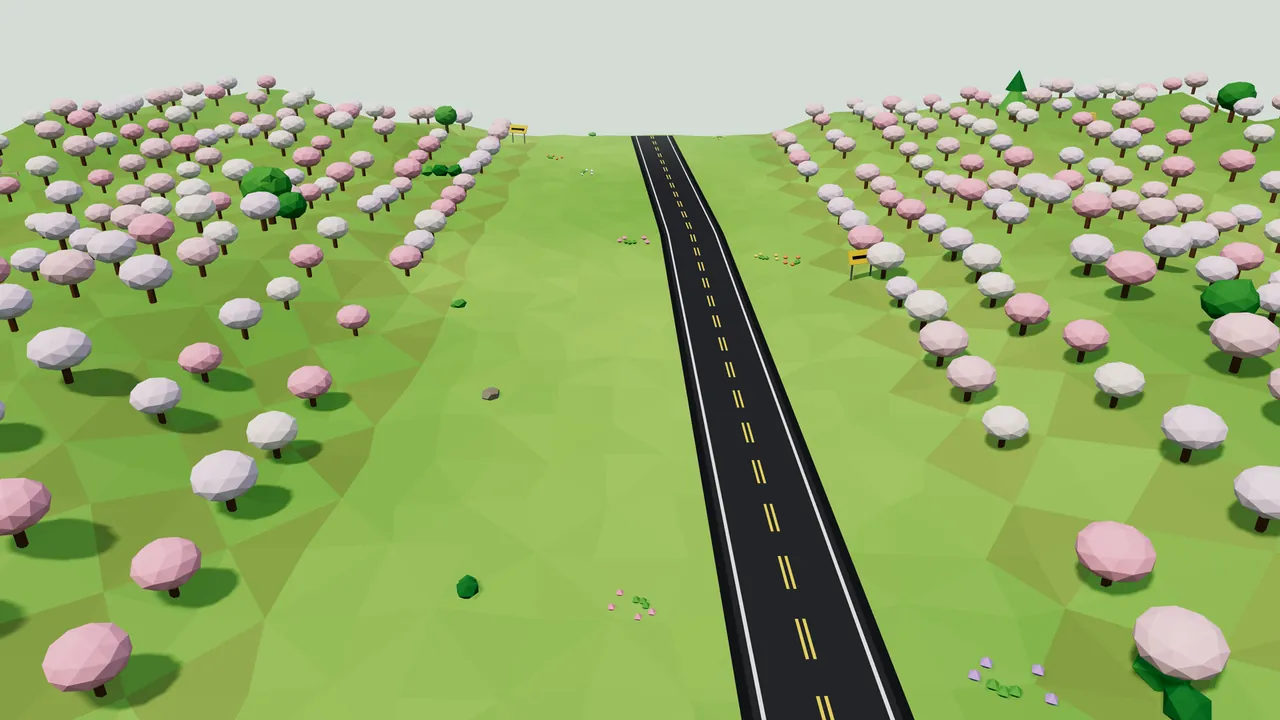
The Paver marks the edge of the corridor too. In about a third of the chunks, one of its road signs, a yellow board with a black arrow band on two legs, stands just outside the corridor. On road fields, half of the chunks also get a yellow-and-black striped barrier, the only prop allowed to stand on the asphalt.
A box of props
At the sides, most pieces choose from five things: round trees, bushes, round hay bales, hedges and fences. Trees win more than half the time. A round tree is a trunk with two lumps of leaves, in four greens. A hedge is five leafy lumps in a row. A fence is an eight-meter run of five posts and two rails. Farther out, past 46 meters, almost half the spots go to pines instead, each one two stacked cones.
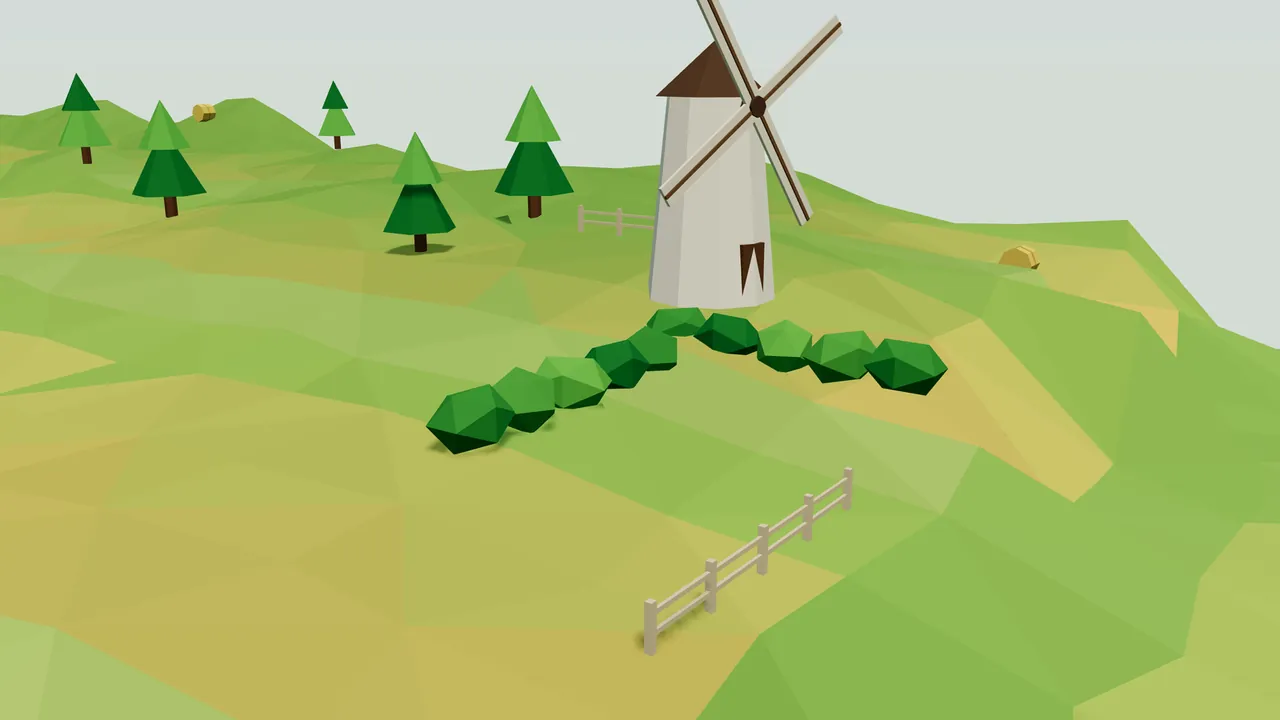
Then come the one-offs. A meadow has a 30 percent chance per chunk of a red barn and an 18 percent chance of a tall white silo. The farm piece swaps the patchwork for crop strips five meters wide, in straw yellow, gold and two greens, and fills its sides with hay, fences, trees and hedges. In almost half of its chunks, a farm windmill appears: a white tower that narrows toward the top, a dark brown cone roof, a brown door and four sails on two crossed spars, turned to face your camera.
Turn the Quality setting down, and the sides and the corridor get 70 percent as many things on Medium and half as many on Low.
Water
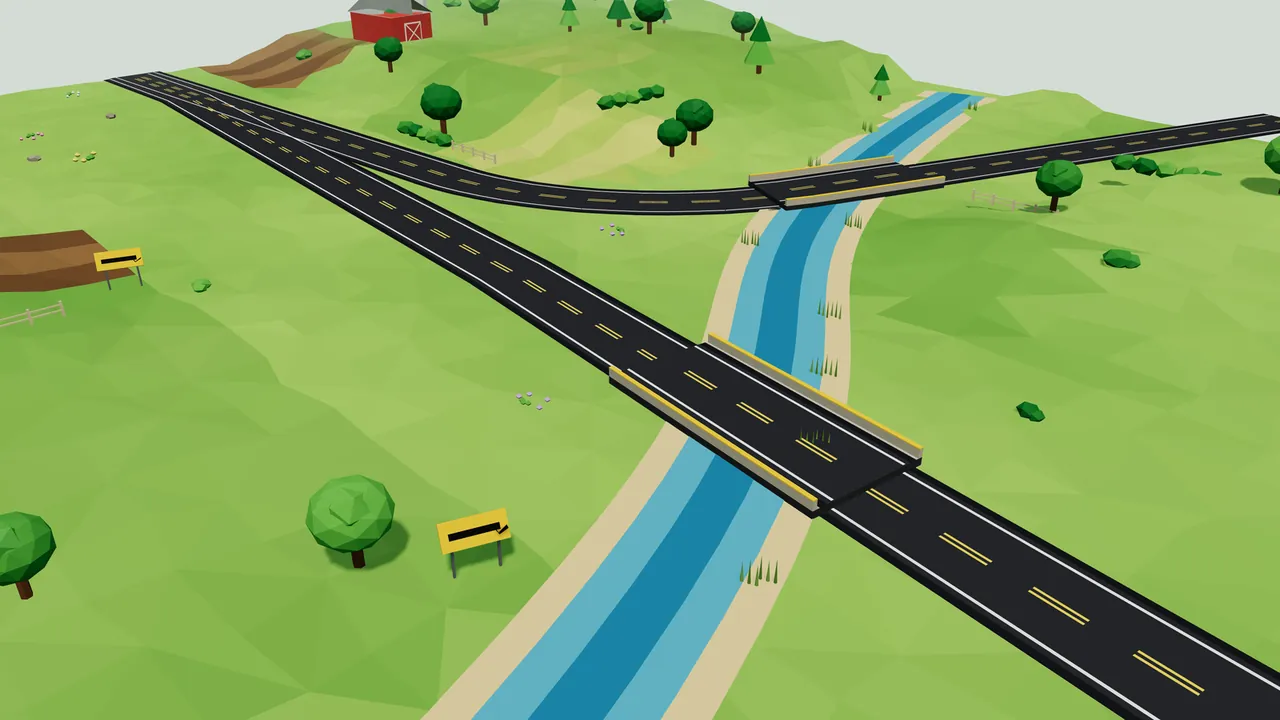
The creek is the one piece that crosses the corridor. It winds across the land from one side to the other: 6.5 meters of water with a deeper blue line down the middle and sandy banks on both sides. It cuts its own bed through the hills, and a clump of reeds grows every six meters, on one bank or the other. Roads never lie on the water, so where one crosses the creek, it goes over on a bridge.
The pond sits beside the corridor, 36 to 48 meters out. It is a round pool 14 to 18 meters across, with a sandy rim, a darker deep spot off to one side, seven clumps of reeds around the edge and a little wooden dock pointing toward the corridor. A windmill turns up in about a quarter of pond chunks, like the one on the cover.
Never a target
None of this scenery can be hit. Shots pass straight through the trees and barns, and nothing in the kit ever breaks. Each prop is built once, then baked into the chunk it stands in, so a whole chunk of trees, hedges and barns is drawn in one go.
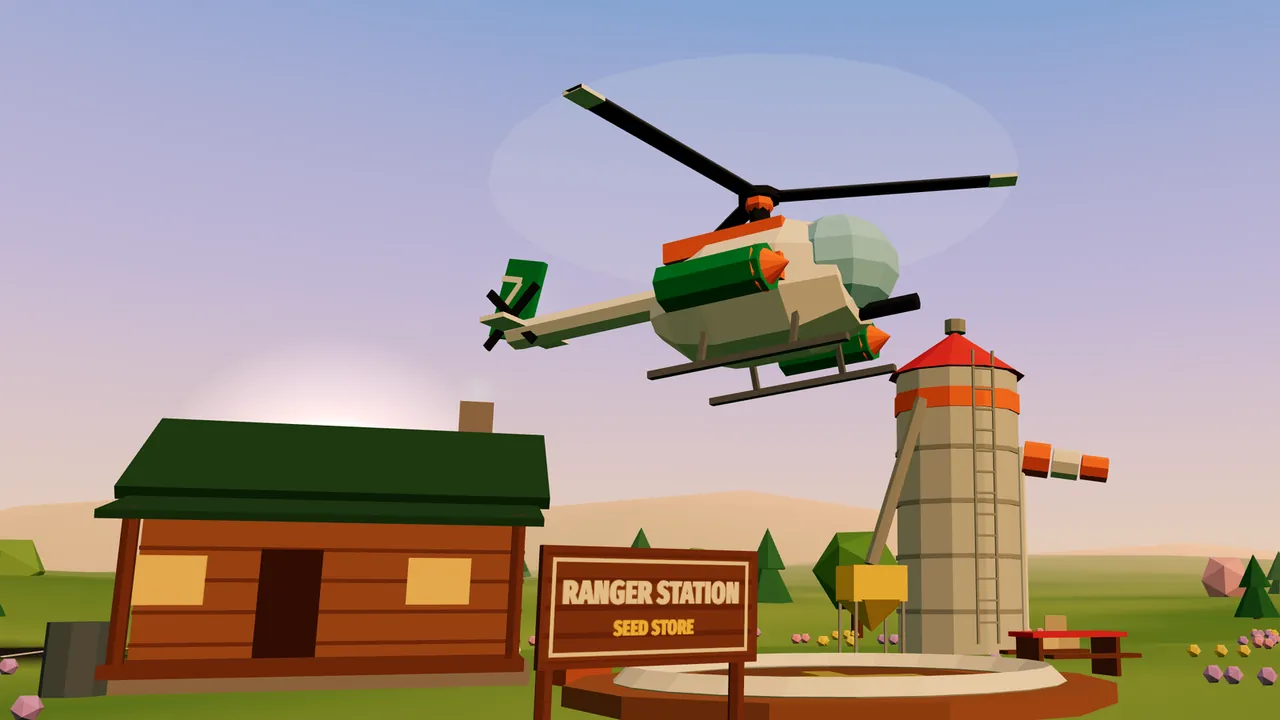
The dice are rolled differently for each level, too, so each level grows its barns and trees in spots of its own. Only the start stays the same on purpose: every level begins at the ranger station, with the Greenfold barn across the corridor.
Fly over it
World 1, Greenfold Meadows, is free to play in your browser at helicorn.com. The full game, all six worlds, is $4.99, paid once. More about the game is on the Helicorn page.