Turbo Pudding

Chalkstep Terraces is the third reach of the Long River in Kettlecrest, and the River sums it up in one line: “White lime terraces and blue basins. The water steps down the hill like a giant staircase.” It sounds made up. It isn’t: real hillsides build stone staircases out of hot water, and this Thursday we’re looking at how.
Where the water starts
Every reach begins at the head of its river, just behind the starting rope. On Chalkstep, the river comes out of a dark mouth under six white lime steps, each one rounded over at the front, with thin sheets of turquoise water falling over a few of them. That’s Juno at the top of this post, a few seconds after the rope drops, with the steps behind her.
In the real world, steps like these grow out of hot springs. At Mammoth Hot Springs in Yellowstone National Park, the water starts as rain and snow on the surrounding mountains. It seeps deep underground, gets heated and rises back up through limestone, picking up dissolved calcium carbonate as it goes. At the surface, carbon dioxide escapes, and the calcium carbonate stays behind as a rock called travertine. The National Park Service calls it “the chalky white rock of the terraces.” So when Dame Dambury names her dam after chalk, she isn’t that far off.
Rims, pools and little dams
Travertine builds a terrace from its edges. The U.S. Geological Survey, which studied Mammoth in detail, describes semicircular ledges called terracettes, from about 1 to 8 feet wide, that form as travertine settles around the rim of a slowly rising pool. Where hot water runs downhill, they stack up into whole staircases. In some places, water gets trapped behind ridges of travertine that work like natural dams, and the pond slowly fills in until it becomes a big flat terrace.
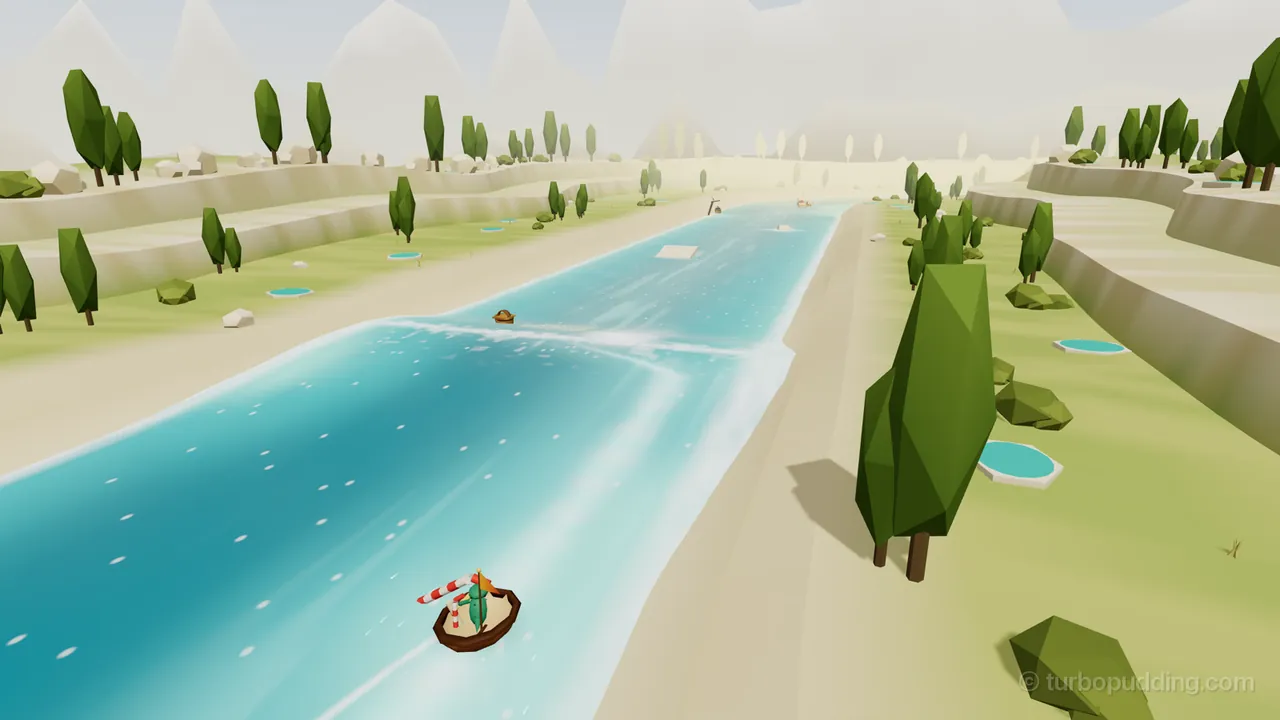
On Chalkstep, the banks climb the same way, in two terraces: a sheer white riser, a flat green step with a lime lip, then the same again. Small turquoise pools in white rims sit on the green steps among poplars, olive shrubs and white limestone boulders.
When a basin brims over
Real terraces never sit still. The park service calls them living sculptures: the travertine piles up so fast that vents clog, new ones open and old ones come back, and the water may gather in a few springs or spread out across many. Scientists estimate that only about 10 percent of Mammoth’s water is on the surface at any moment.
The game’s version of that restless water is the upper basin: a lime bowl on a mound on the bank, with a notch in its lip facing the river. Before it pours, its rim glitters and the water climbs. Then a sheet of water pours across the nearest lane for two seconds, pushing boats sideways and slowing them down. At the Spill Gate in Turquoise Basin, two of these basins take turns, left, then right, four seconds apart, so one lane is always open. The race runs two laps, so a basin that was quiet the first time can be pouring the second.
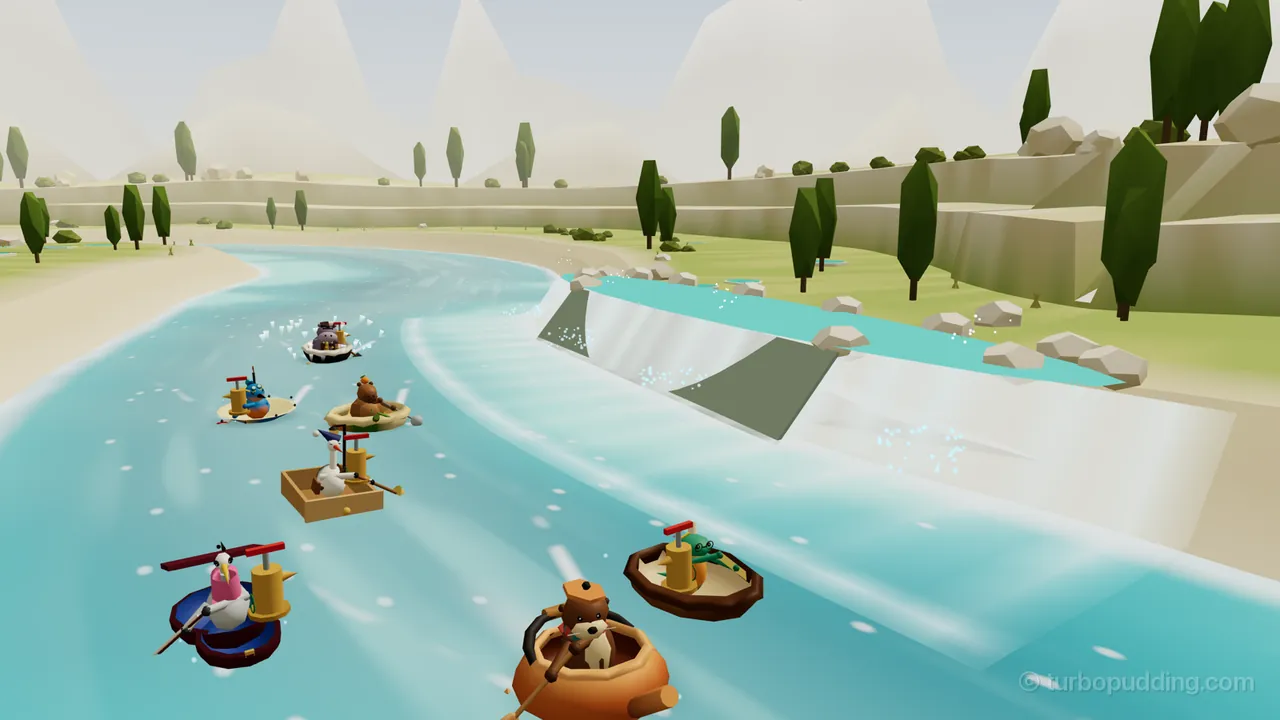
Under each notch, a gray-green stain of wet travertine runs down to the river. Real terraces have colors of their own. Tiny organisms called thermophiles, a name that means heat lovers, paint the runoff: colorless and yellow ones grow in the hottest water, and orange, brown and green ones in cooler water. When a spring stops flowing, they die, and the travertine turns white and then a dingy gray.
The biggest staircase of all
The largest deposit of travertine in the world is at Pamukkale, in western Turkey. The name translates as “cotton castle” or “cotton palace,” after its bright white rock. According to NASA, its white terraces and rimstone pools, pools held in by rims of rock, cascade down cliffs about 650 feet high. The deposits cover about 5 square miles and have been forming for at least 600,000 years. In the second century B.C., the ancient city of Hierapolis was built right on top of the terraces, and in 1988 the site was named a UNESCO World Heritage site.
Back at Mammoth, the Shoshone and Bannock people collected minerals from the terraces for hundreds of years to make white paint.
Down the White Chute
Chalkstep ends with Chalk Dam, the longest run of the reach. Dame Dambury has plastered her dam with lime, with pale bands between the logs and a white crest of lime mud. The way down is the White Chute, a smooth lime spillway between plastered walls and the steepest stretch of the river up to that point. Dame Dambury is very sure of her building material: “Chalk doesn’t float, and chalk doesn’t splash.” Whether her dam can hold back the Long River is something you’ll have to see for yourself.

The first two reaches, Glacier Gate and Pinewood Rapids, are free to play in your browser at kettlecrest.com. The full game, all six reaches to the sea with Chalkstep Terraces among them, is $4.99, paid once. More about the game is on its Kettlecrest page.