Turbo Pudding
Out in the Airwaves, the galaxy of Loudnik, sound carries through space, and every planet is a radio station with its own song. Then Monotone, a conductor machine, decides there is only one right sound in the universe: a clean A at 440 hertz. Everything else is noise. It’s Thursday, the day for the real story, and that one sentence holds two of them. A real radio station has been playing that very A since 1936, and real space turns out to have a note of its own.
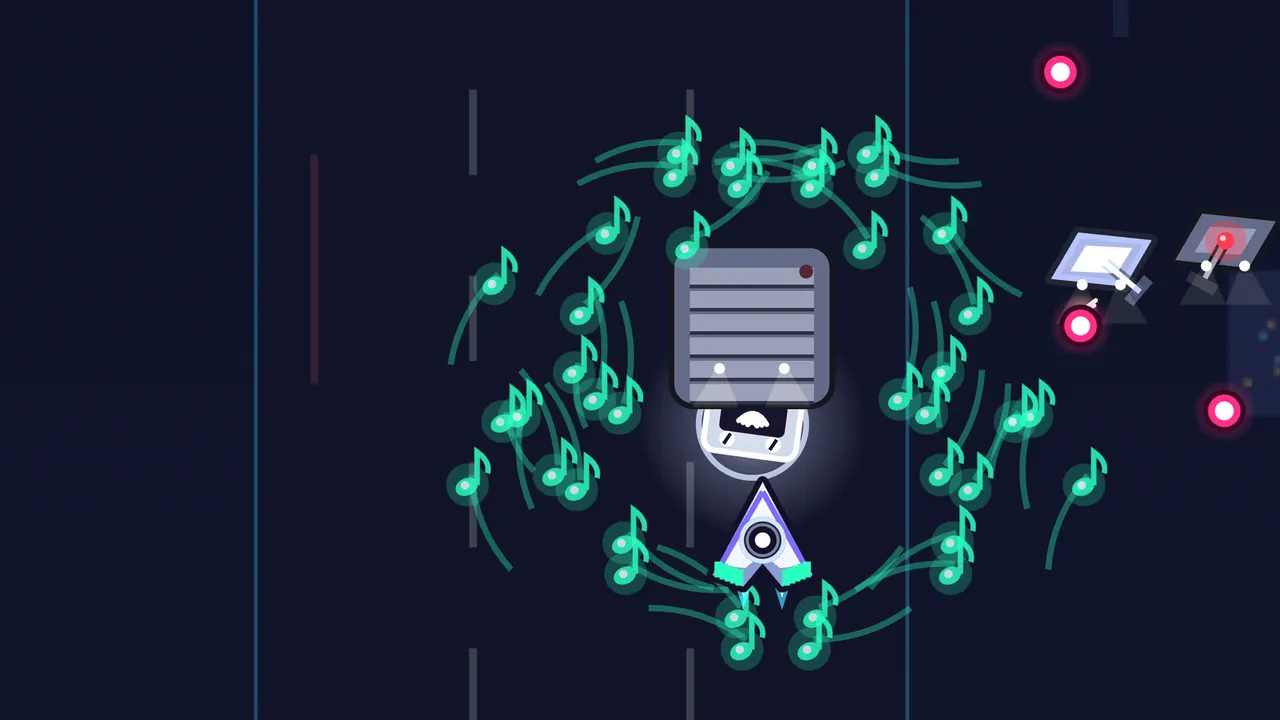
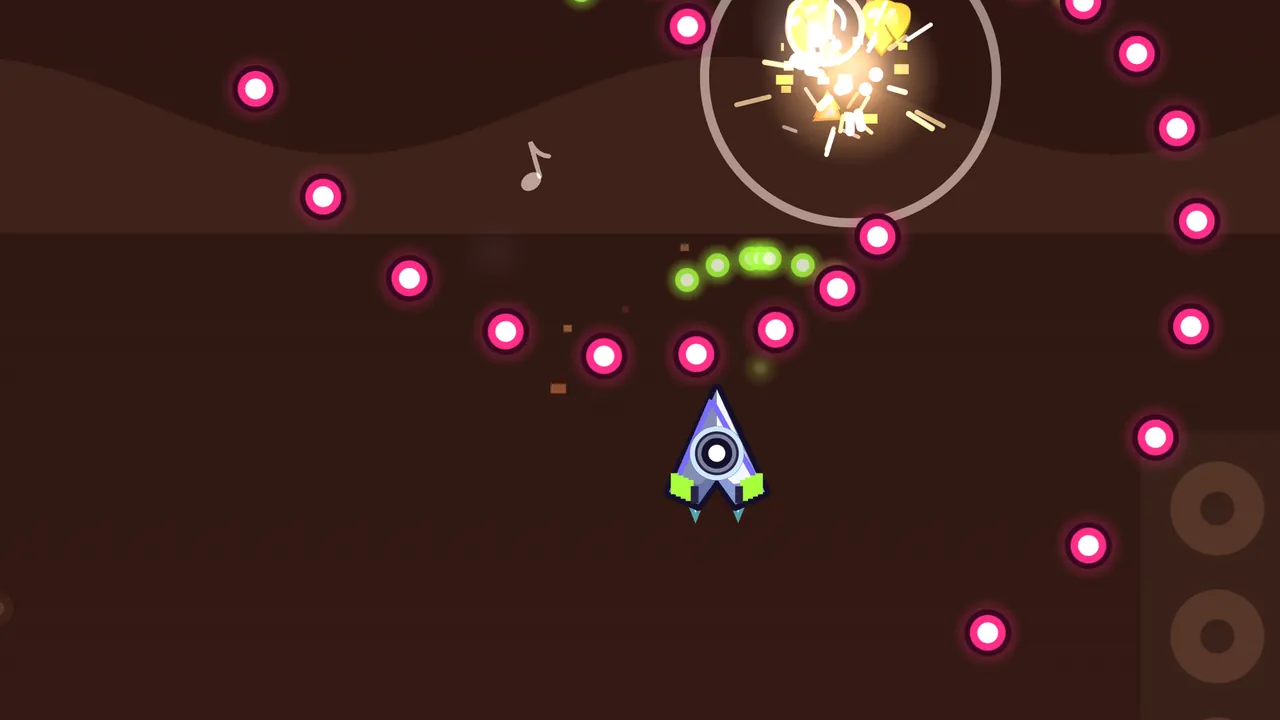
The picture at the top is Night Highway, the neon city where every billboard shows Monotone. Volta’s ship has flown right up under one of his Jammers, a gray box with slats and a red light in the corner, and the green notes of her shots are swirling all around it.
A note with a number
440 hertz means 440 vibrations every second. On a piano, it’s the A just above middle C. Monotone’s whole plan comes down to that one number. As far as he’s concerned, everything else is noise.
Under the hood, every note in Loudnik is worked out from that same number. The game plays its songs live, and to find the pitch of any note, it starts from A at 440 hertz and counts up or down from there. So every song Volta fires at the Jammers is tuned, quite literally, to Monotone’s favorite note.
You can even hear the A on its own. When a boss arrives, a warning sounds three times. Each starts on exactly 440 hertz, then slides up and away, with a lower A, at 220 hertz, humming underneath.
A real station that plays it
Monotone would be pleased to learn that his A is already on the air. In the United States, the National Institute of Standards and Technology, NIST for short, runs a radio station called WWV, and once an hour it broadcasts a steady 440-hertz tone.
The station began with test broadcasts from Washington, D.C., in May 1920, and what it played back then was concerts, on Friday evenings. In January 1931 it moved to College Park, Maryland. The tone arrived in August 1936, added at the request of several musical organizations. In 1966, the decision was made to move WWV to its current home near Fort Collins, Colorado. So the station that plays Monotone’s note got its start with Friday night concerts. Volta would approve of that part.
The A still goes out today, on a schedule: in the second minute of each hour on WWV, and in the first minute on WWVH, NIST’s other station. It’s left out in the first hour of every day, counted in Coordinated Universal Time. And these days it isn’t really for musicians. It works as an hourly marker for chart recorders and other automatic machines.
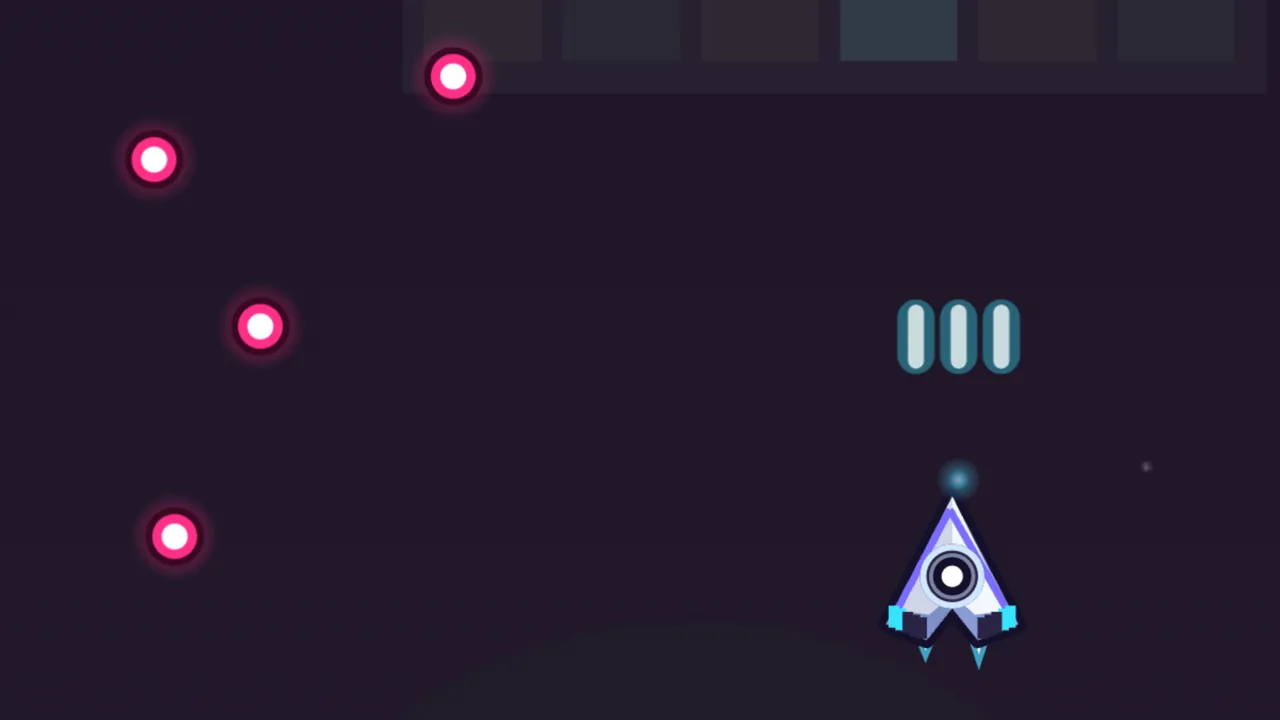
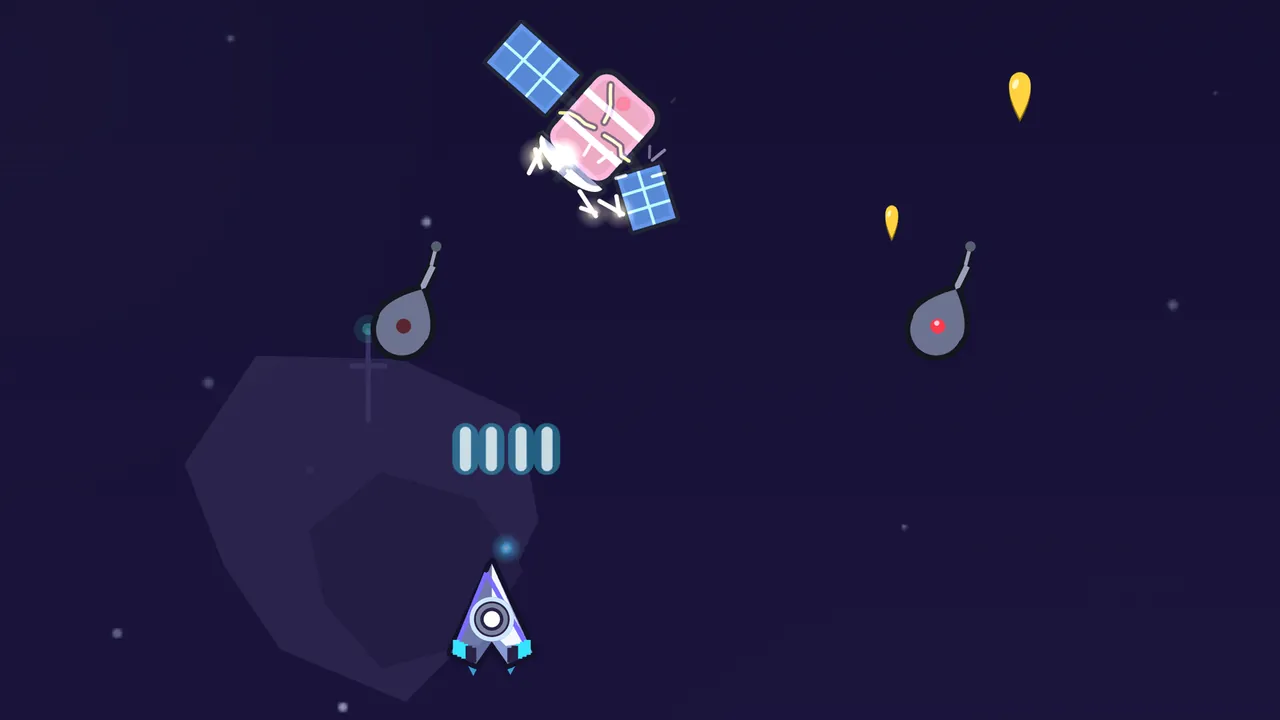
Volta’s hideout, Pirate Cove, is an asteroid belt full of old relay masts.
Could sound really cross space?
In the Airwaves, sound carries through space. In our universe, it mostly can’t. NASA explains where the popular idea that there’s no sound in space comes from: most of space is close to empty, so sound waves have nothing to travel through.
Radio has no such problem. Radio waves belong to the same family as light, the electromagnetic spectrum, and they travel at the speed of light, 299,792,458 meters per second in a vacuum. That’s how NASA talks to its spacecraft. The New Horizons probe uses a dish antenna 2.1 meters across to keep in touch with Earth from as far as 7.5 billion kilometers away. A real pirate station in space would have to broadcast by radio.
The lowest note in the universe
Space isn’t completely empty, though, and in one place it really does sing. The Perseus galaxy cluster, 250 million light-years from Earth, is full of hot gas, and the black hole at its center sends out pressure waves that make ripples in that gas. In 2003, NASA reported that those ripples add up to a note.
The note is a B flat, 57 octaves below middle C. A regular piano covers about seven octaves. The frequency is more than a million billion times lower than the lowest sound a human can hear, and it’s the deepest note ever found coming from any object in the universe. It has kept roughly the same pitch for about 2.5 billion years.
In 2022, for NASA’s Black Hole Week, the sound was finally turned into something people can hear. To get there, it was raised by 57 and 58 octaves, which means 144 quadrillion and 288 quadrillion times higher than its real frequency.
So Monotone has a rival. He wanted the whole universe on one note, and it turns out the universe already had one. It isn’t even an A. It’s a B flat, the very next key up on a piano, only a long, long way further down.
Pirate Cove, Disco Rings and Bell Garden, the first three stations, are free to play in your browser at loudnik.com. The full game, all ten stations, is $4.99, paid once. More about the game is on its Loudnik page.