Turbo Pudding
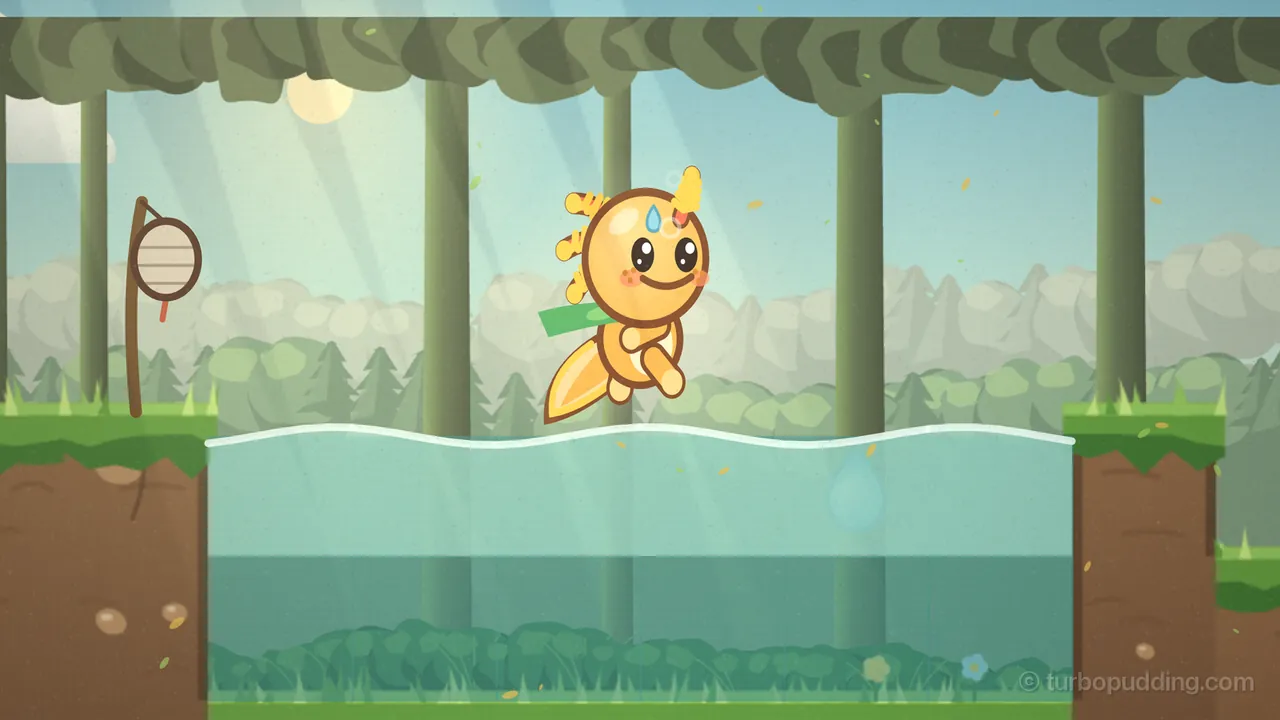
Gilby is an axolotl, and an axolotl is at home in two places: on dry ground and in water. So Pitterplop moves him by two sets of rules. On land he runs, jumps and bounces. In water he swims wherever he likes, and one push near the surface sends him flying out. At the top of this post, he’s doing just that, leaping out of a little woodland pool in Hedgerow Hush.
This Wednesday, here’s how those moves are tuned, with the real numbers from the game.
One tile, a tenth of the screen
Everything in Pitterplop is measured in tiles. A tile is 48 pixels square, and Gilby stands about one and a half tiles tall, roughly a tenth of the screen’s height. That’s big enough to read his face on a phone and small enough to see the next ledge coming.
On the ground, he never starts or stops dead. He reaches full speed in under a fifth of a second, slows down when you let go, and brakes almost twice as hard when you press the other way, so turning around feels snappy. At full tilt, he covers more than six tiles a second. In the air, he still answers the arrows, a little more gently.
Hold for a leap, tap for a hop
The game’s first tip says: “Hold jump to leap higher, tap for a small hop.” Behind it, a held jump lifts Gilby about 3.4 tiles. Let go sooner, and the game keeps only 42 percent of his upward speed, so a quick tap gives a hop of about 1.3 tiles. Anything in between is yours to choose.
The rise and the fall don’t feel the same, on purpose. Gravity pulls about one and a half times harder as he falls, so landings are quick and sure. And while you hold the button, Gilby floats for a beat at the very top of the jump, where gravity drops to about half. That tiny pause is when you line up a landing.
Squash and stretch
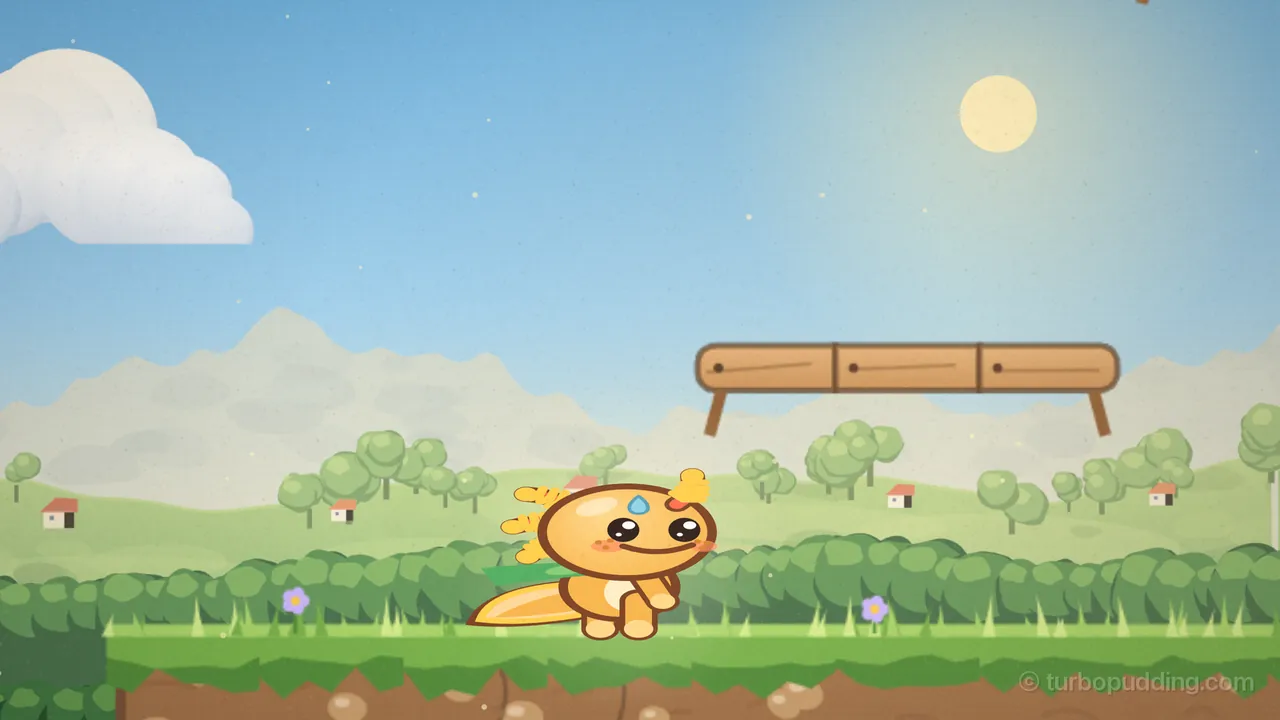
Animators have an old trick called squash and stretch: a body that squishes when it lands and stretches when it takes off looks soft and alive. Every jump stretches Gilby for a moment to 78 percent of his width and 125 percent of his height.
A landing does the opposite. The harder he lands, the bigger the squash, up to 35 percent wider and almost 30 percent shorter after a long drop. Then he springs back to his usual shape in a fraction of a second.
Small helpers you never notice
If Gilby runs off a ledge and you press jump a split second late, he still jumps: the game gives you seven extra frames, about a tenth of a second. If you press jump just before he lands, the game remembers it for eight frames and jumps the instant his feet touch down.
Corners get the same kindness. If the edge of his head clips a block by up to 10 pixels as he rises, he slides around it instead of bonking to a stop. And a low lip, up to 30 pixels high, a bit more than half a tile, he simply walks up without jumping at all.
Three kinds of trampolines
Pitterplop has three things to bounce on. The springy mushroom launches Gilby about six tiles up, nearly twice as high as his best jump. It also stretches him even more than a jump does.
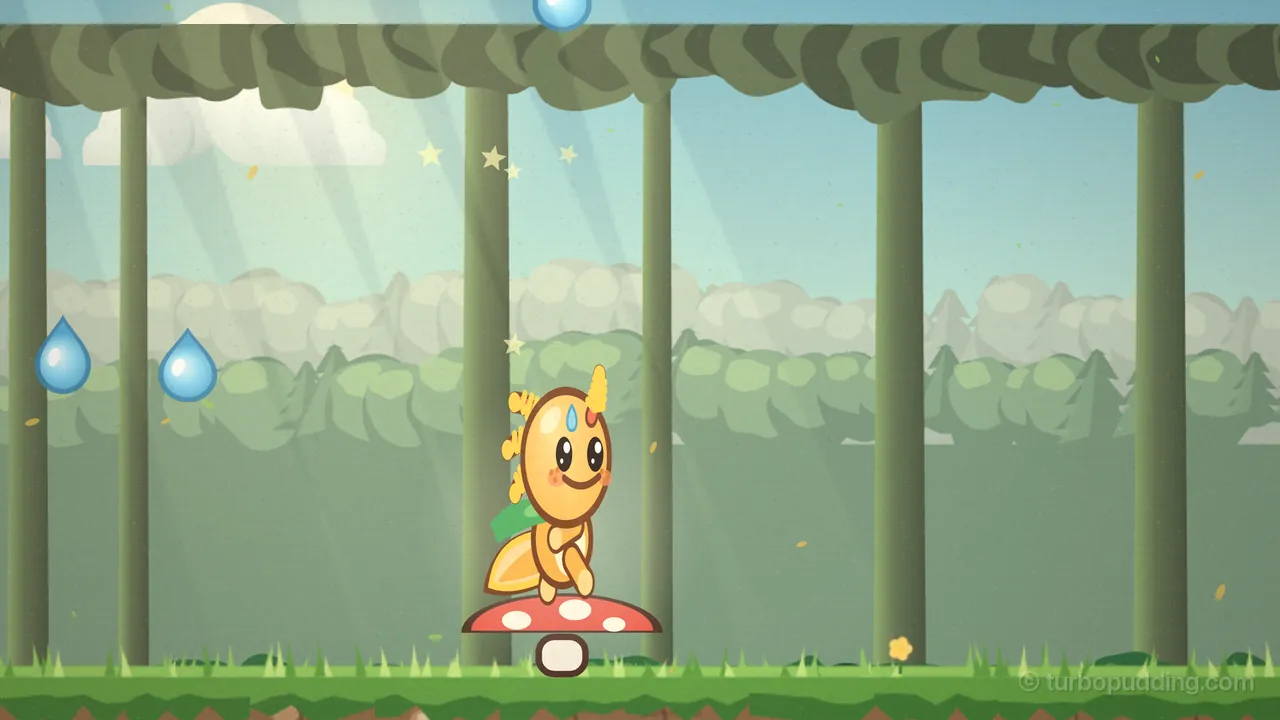
Glowcaps, the shining mushrooms deeper in Mossy Hollow, are gentler. A plain landing bounces Gilby about two and a half tiles, and holding jump doubles that to about five. Big glowcaps push 20 percent harder.
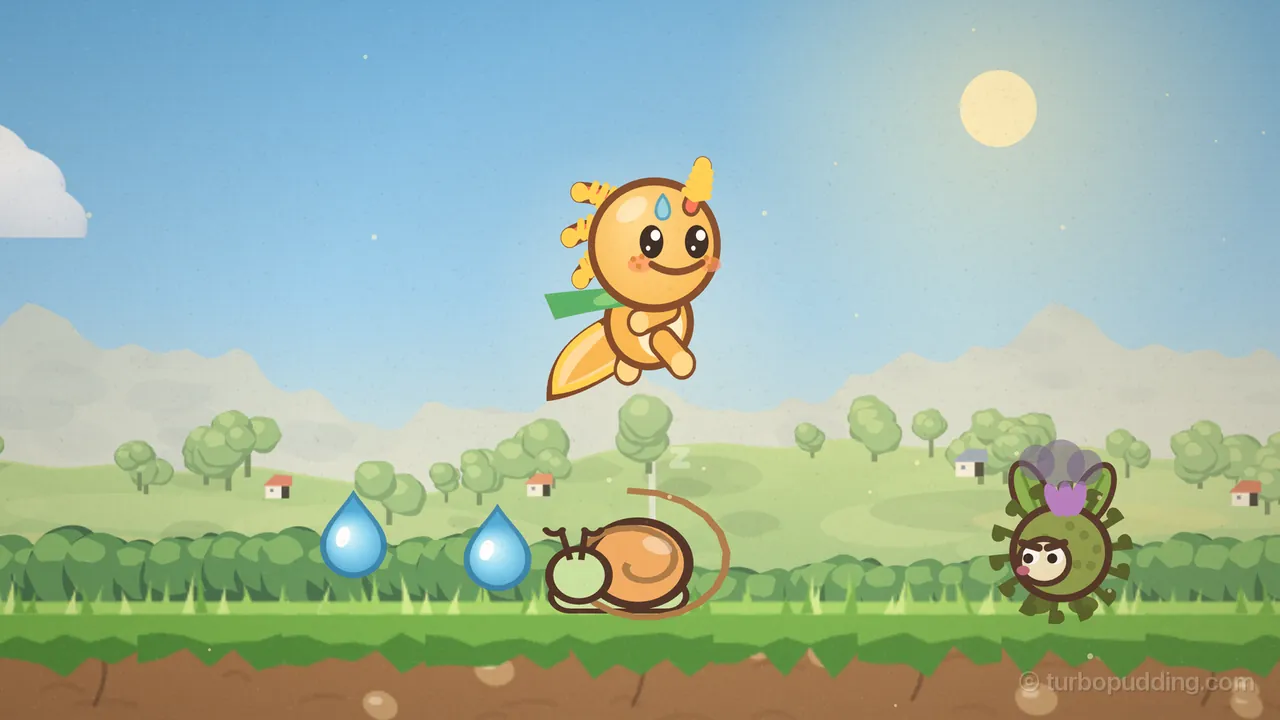
Then there are the critters. Once a grumpy snail or frog has been stomped to sleep, its back turns into a pillow. Hold jump as you land on it for a big bounce of about five tiles. Don’t, and you get a softer bounce that dies down after a few hops, until Gilby can stand right on top.
At home in water
The moment water reaches Gilby’s middle, the land rules switch off. He swims freely in every direction, a little slower than he runs, and the water softens every move, so he glides instead of darting. Left alone, he drifts slowly up toward the surface. Jump turns into a flick of the tail that pushes him upward.
Near the surface, that flick becomes a leap. We made the check generous: if his head is just under the water, it still counts, and he shoots out almost as high as a full jump. Diving in is the opposite: a big fall into water loses about two-thirds of its speed at once, with a splash.
Water also heals. Axolotls are famous for regrowing what they lose, so while Gilby swims, lost hearts come back one at a time, one every two and a half seconds.
The first two levels of Pitterplop, Dewdrop Meadow and Puddle Path, are free to play in your browser at pitterplop.com. The full game, with all of Mossy Hollow, is $4.99, paid once. More about the game is on its Pitterplop page.