Turbo Pudding
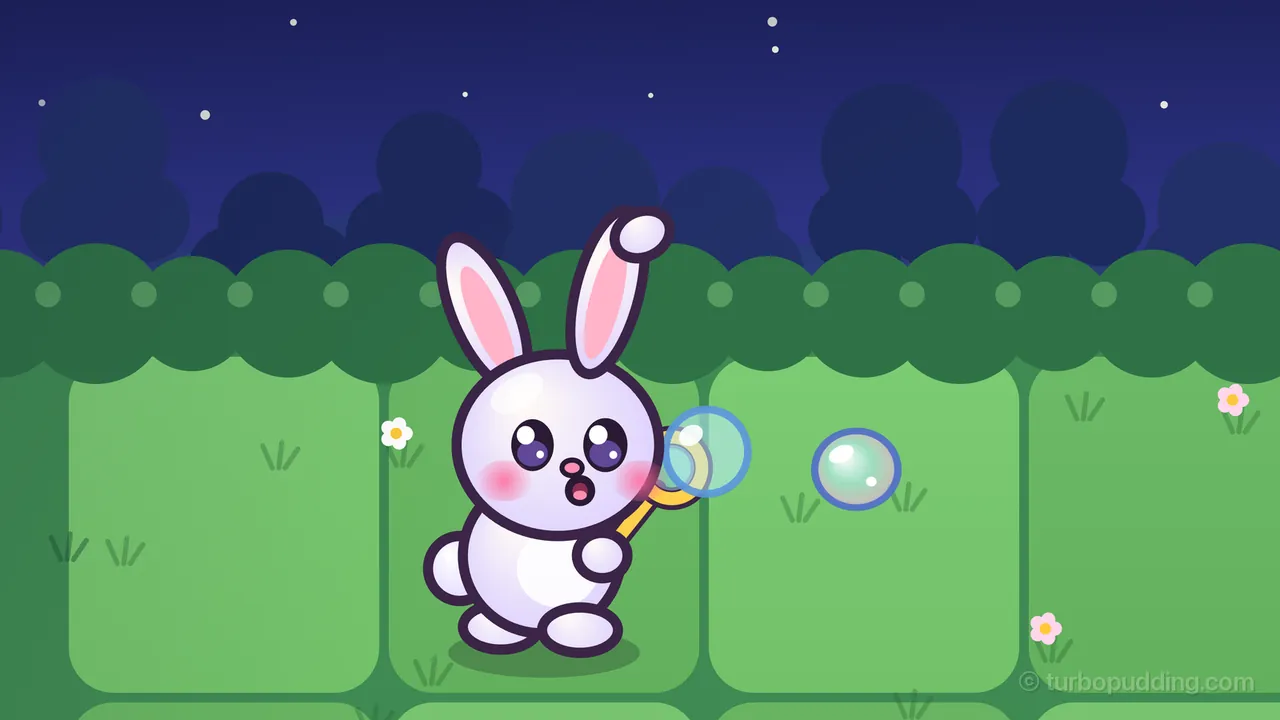
Bubbun is the first Fluff you meet in Fluffenders: a white bunny with a yellow bubble wand that blows sleepy bubbles at every Grump in its row. At the top of this post, it’s blowing one on the top row of the lawn.
This Sunday, we’re opening the sketchbook. Here’s how a Fluff is drawn, with Bubbun as our model.
A recipe instead of a picture
Fluffenders keeps none of its characters as image files. Each Fluff is a short recipe in code: ovals, circles, a few curves and the colors to fill them with. When you play, the game paints every look of every Fluff once, at the resolution of your screen, and then reuses it like a sticker. That keeps the edges crisp on any screen.
A few rules hold for every Fluff. All of them face right, toward the Grumps. Each one stands on a single point, the middle of its feet. Ten of the sixteen Fluffs, Bubbun included, are drawn inside the same box, 136 by 150 units. The outline is a deep plum, never black, and eyes and mouths use an even darker ink. Every shape gets a soft shading that’s lit from the top left. A note in our code calls it the soft plush look.
Bubbun, layer by layer
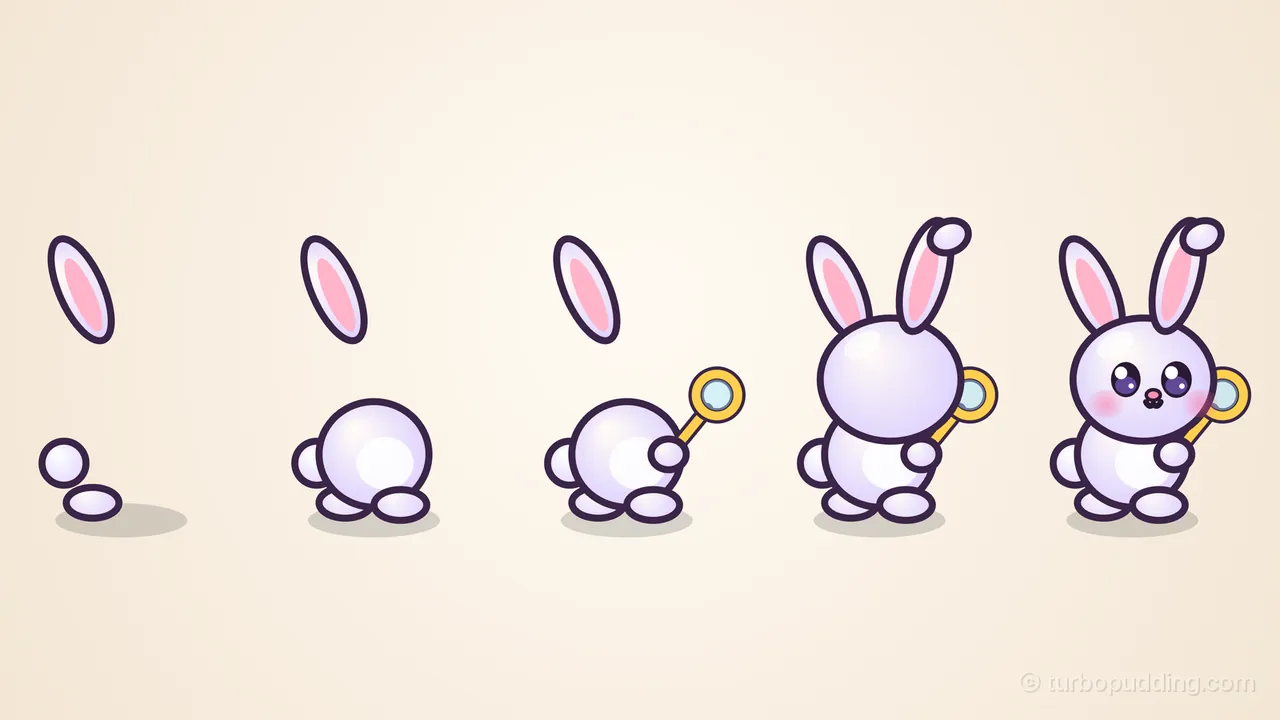
A Fluff is painted from back to front, like a paper cutout. Bubbun’s recipe starts with the parts that sit farthest away: its round puff of a tail, the back ear and the back foot. Then come the body, a plump oval with a white belly patch, and the front foot.
Next is the wand, a yellow stick with a ring on top. Each line is drawn twice, a thick plum stroke under a thinner yellow one, so the outline wraps all the way around. Inside the ring goes a pale blue film of soap. A round paw goes over the stick, so Bubbun really holds it.
Then the head, the biggest part of all: 64 units wide, while the body is only 50. A big head on a small body is an old trick for making a character look cute. The head gets a white shine at the top left, and then the front ear goes on, with its tip flopped over.
The face comes last: two eyes, two pink cheeks, a pink nose and a tiny cat mouth shaped like a w. All in all, a plain Bubbun takes 40 fills and outlines. Below, each step adds the next few of them, in the game’s own order.
Eyes do the talking
An eye is a recipe of its own, in four layers. First comes a dark oval, a bit narrower than it is tall. A soft lilac glow fills its lower half. A big white shine sits at the top left, and a small white dot sits at the bottom right. The two white spots make it glossy.
The same Bubbun has several faces. When a Grump comes down its row, the eyes shift toward it, so Bubbun watches it coming. Every two to five seconds, Bubbun blinks, and for about a seventh of a second its eyes turn into two soft curves. In the middle of a stretch, they close into happy arches. And on every shot, the mouth opens into a round O, a bubble forms on the wand and the pink cheeks get brighter.
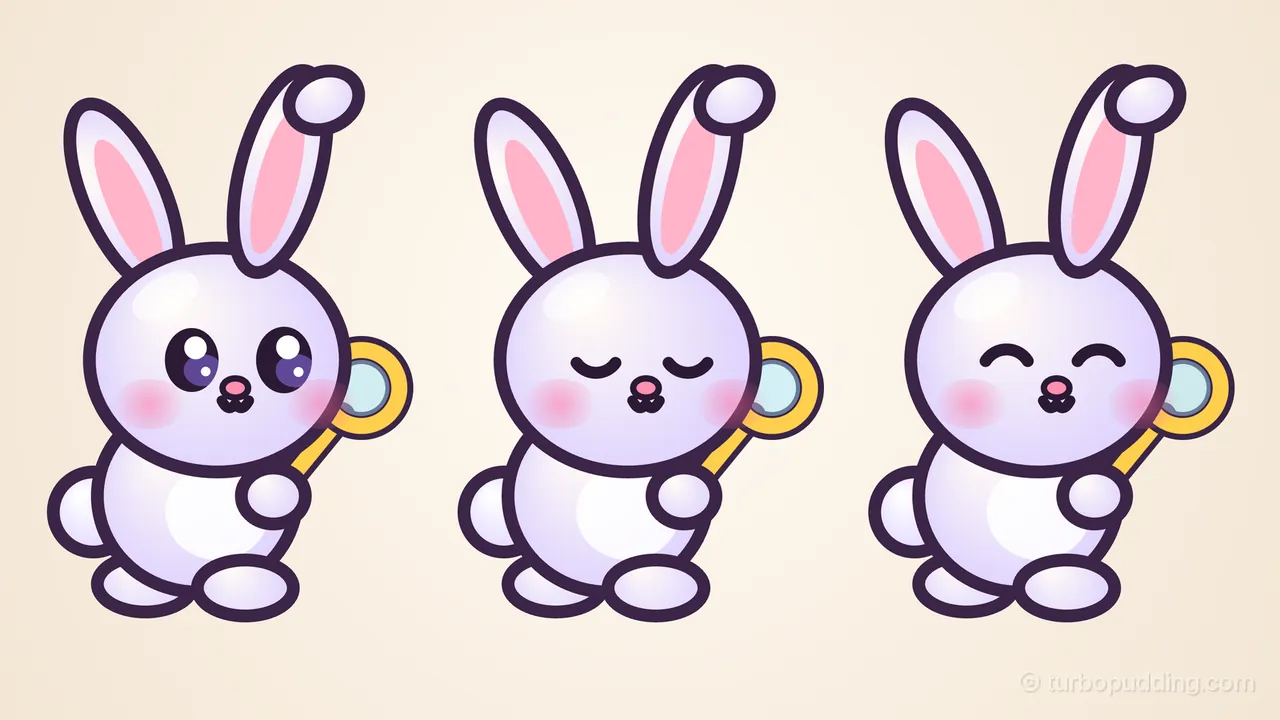
Each face is a sticker of its own, and on every frame the game picks one: a shot beats a blink, a blink beats a stretch, and a stretch beats watching a Grump.
Alive between shots
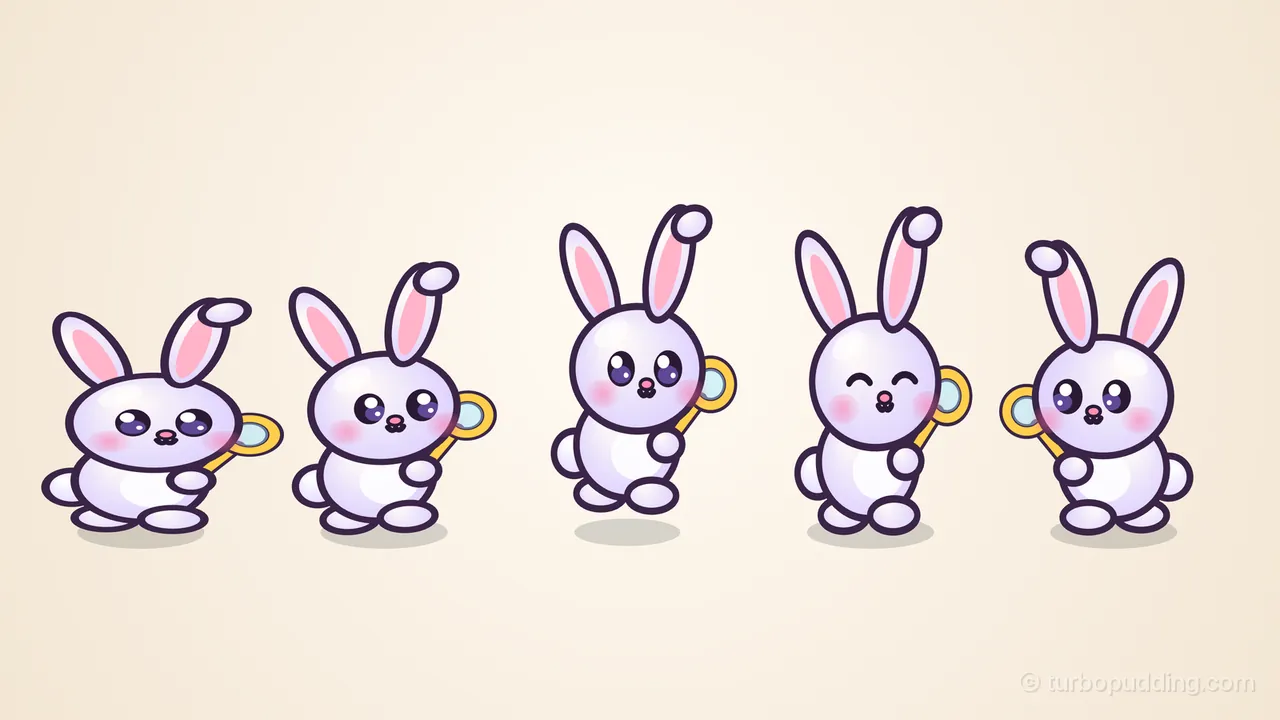
Every Fluff breathes: it grows a little taller and thinner, then a little shorter and wider, about once every two seconds. Each one breathes to its own beat, so a full lawn never moves in step like a marching band.
Putting a Fluff down is a tiny drop. It falls in from 18 units up, stretched tall, and lands with a squash, a quarter wider and a fifth shorter than usual. Then it springs back within a quarter of a second, overshooting just a little, the way something soft would.
Just before a shot, Bubbun squashes down and leans back for about a sixth of a second. On the shot itself, it pops up taller and rocks back 3 units from the push.
And when nothing’s happening in its row, a Fluff gets bored. It first happens after 5 to 15 seconds, then every 8 to 15. It picks one of three things: a couple of little hops, a big stretch with happy closed eyes, or a peek. To peek, it leans toward the Grumps’ side, turns round to glance back at the burrow and turns back again. The moment a Grump shows up in its row, playtime is over. Dozy Mole and Glowshell Snail only ever peek and stretch. As a note in our code points out, a mole can’t hop out of its hole.
The first two nights of Fluffenders are free to play in your browser at fluffenders.com. The full game, all twenty nights, is $4.99, paid once. More about the game is on its Fluffenders page.