Turbo Pudding
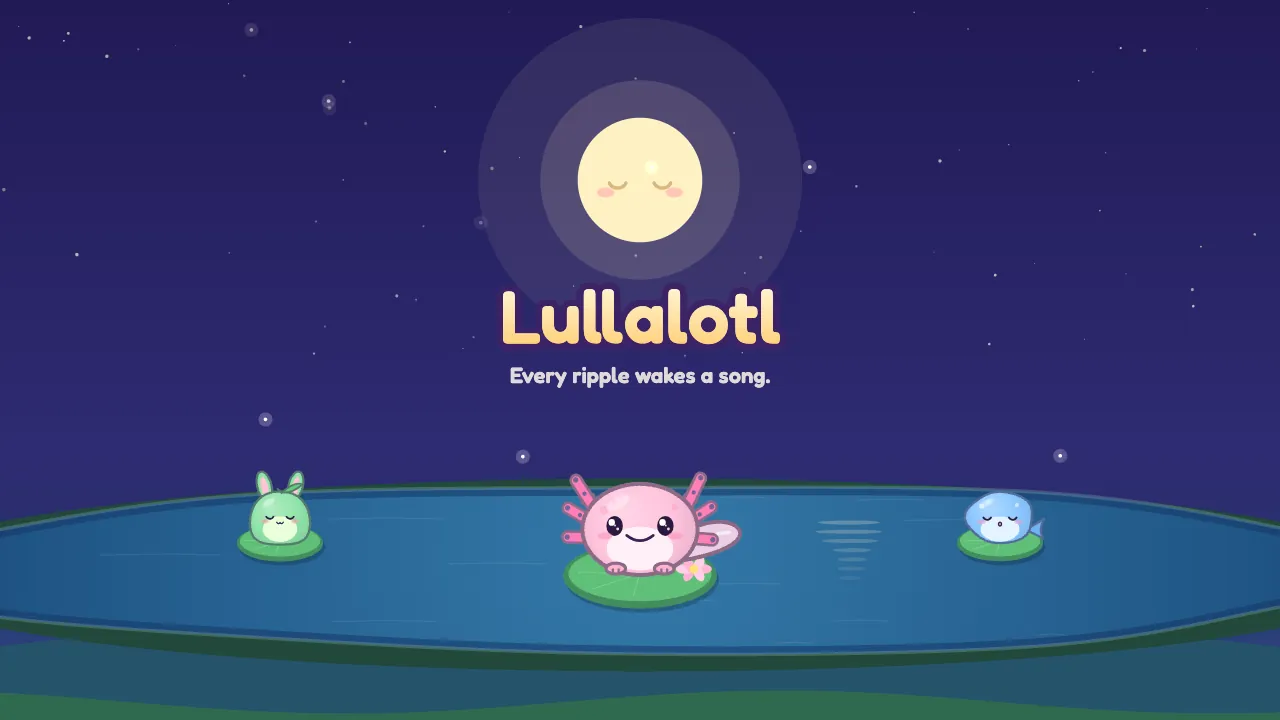
In Lullalotl, the hero is Lulla, a tiny pink axolotl who can’t sing. When the Hush makes Moonlit Hollow so quiet that the songs sink and the colours fade, she is the only one who stays pink. Her tail goes plip, the ripple touches a sleepy friend, and the friend starts to sing.
Lulla lives in a made-up pond under a made-up Moon. Her real cousins live in one very real place, and they are even stranger than she is.
A salamander that never grows up
An axolotl is a salamander, a cousin of the tiger salamander. Most salamanders start life in the water with gills, then change: the gills go, the lungs take over and the grown-up walks off onto land. The axolotl skips that change. It grows up, and even has young of its own, while keeping the body of a baby.
That is where its famous look comes from. The feathery fronds on each side of its head are gills, three on each side. It keeps them all its life and stays in the water from start to finish. Add the wide mouth that seems to be smiling and you get the face everyone knows.
One lake system in the world
Wild axolotls live in only one place: the old lakes of the Valley of Mexico. The big lakes that once filled the valley were drained over the centuries as Mexico City grew. Today the axolotl hangs on mostly in the canals of Xochimilco, in the south of the city.
Xochimilco is a maze of water channels around chinampas, small farm islands built up from the lake bed. People have farmed them since before the Spanish arrived. In 1987 Xochimilco and the historic centre of Mexico City were listed together as a World Heritage Site. The quiet, plant-filled water between the chinampas is just what an axolotl likes.
A water monster with a god’s name
The name comes from Nahuatl, the language of the Aztecs. “Atl” means water, and the word is usually translated as “water monster” or “water dog”. The other half echoes Xolotl, a god of Aztec stories. In one old tale, Xolotl did not want to die, so he hid by changing shape, last of all into an axolotl in the water.
For a creature about the length of a pencil, that is quite a name.
Pink is the rare colour
Here is the part we love. Wild axolotls are not pink at all. They are dark, black or mottled brown and olive, which hides them well in a muddy canal. The pale pink and white axolotls that most people picture are mostly kept in aquariums.
So when Lulla is the only one in Moonlit Hollow who stays pink, she is being an unusual axolotl twice over.
Regrowing what is lost
Axolotls can regrow a lost leg or tail as good as new, bones and all, and can even repair parts of their heart and spinal cord. Very few animals with a backbone can do anything like it. That is why scientists keep axolotls in labs around the world and study how they do it.
Why they need help
The wild axolotl is critically endangered. Researchers at Mexico’s national university, UNAM, counted about 6,000 axolotls per square kilometre of Xochimilco in 1998, and only about 100 in 2008. The water got dirtier, the city spread, and fish that were brought into the canals eat axolotl eggs and young.
The good news is that people are fighting for them. Some chinampa farmers keep clean, sheltered canals for axolotls and grow their crops without poisons, and Mexico has made the axolotl a national favourite. In 2021 the Bank of Mexico put one on the back of the new 50-peso note, swimming in the canals of Xochimilco. The International Bank Note Society later named it banknote of the year.
Back in Moonlit Hollow
Lulla’s own journey runs through ten ponds, from Lily Cradle and Bubble Bend to Frost Mirror, Twin Falls and Moon Mirror, where the last note of the lost lullaby is waiting. On the way she meets ten sleepy singers: Echo, who answers twice, Dozy, who yawns a giant wave, Puff, who sneezes seeds, and the twins Tik & Tok, who do everything together.

The first two ponds are free and play in any browser. Tap the water, and give a little thought to the real axolotls, smiling in the canals of Mexico.