Turbo Pudding
On the night of 21 December 1927, Glimmerau’s Guild of Clockmakers has one job: the Great Winding, which comes once every five hundred years. The Winding Night edition of The Glimmerau Courier puts the Guild on its front page, with a line that says a lot about it: “Seven Masters will attend. In 1890 there were forty.” This Monday, meet all seven, even though most of them are in no state to say hello.
Five give, one climbs
The Winding has a custom, and Provost Crane can recite it in one breath: “Five Masters give a spark, the sixth carries them up, the Provost presides.” Each of the five gives a spark of his own, and the sixth carries all of them up the tower to the Great Clock.
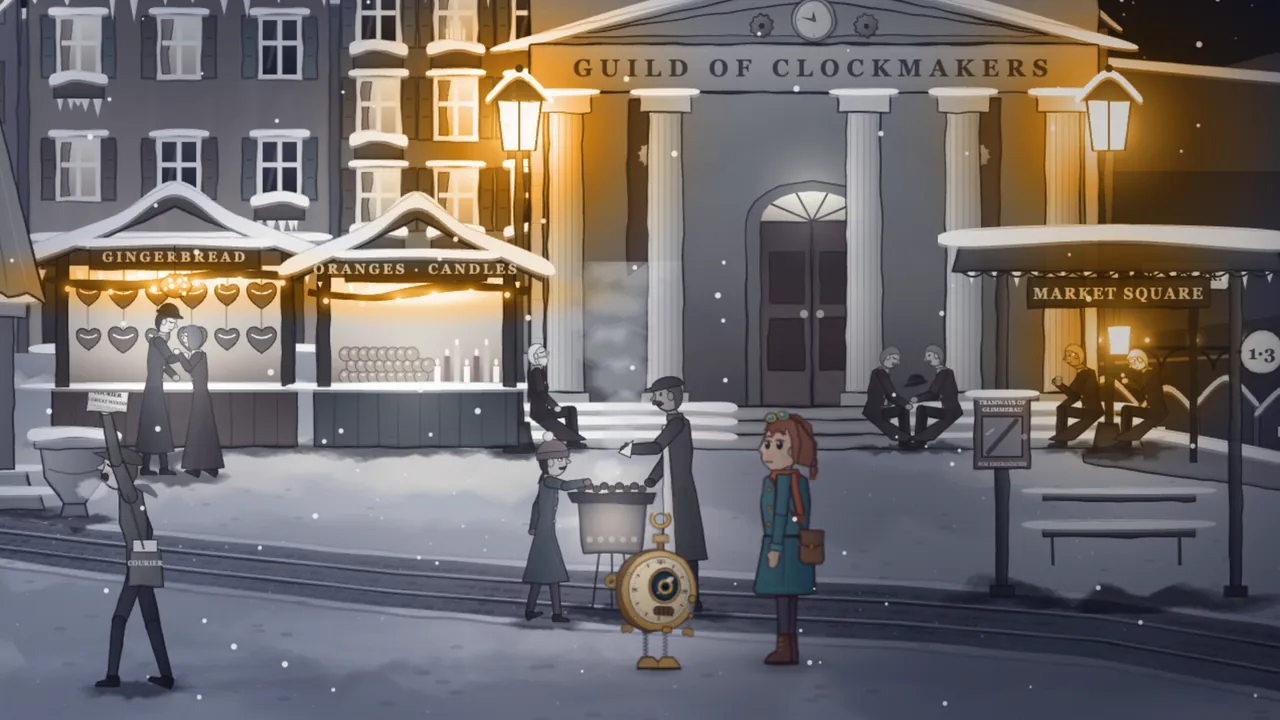
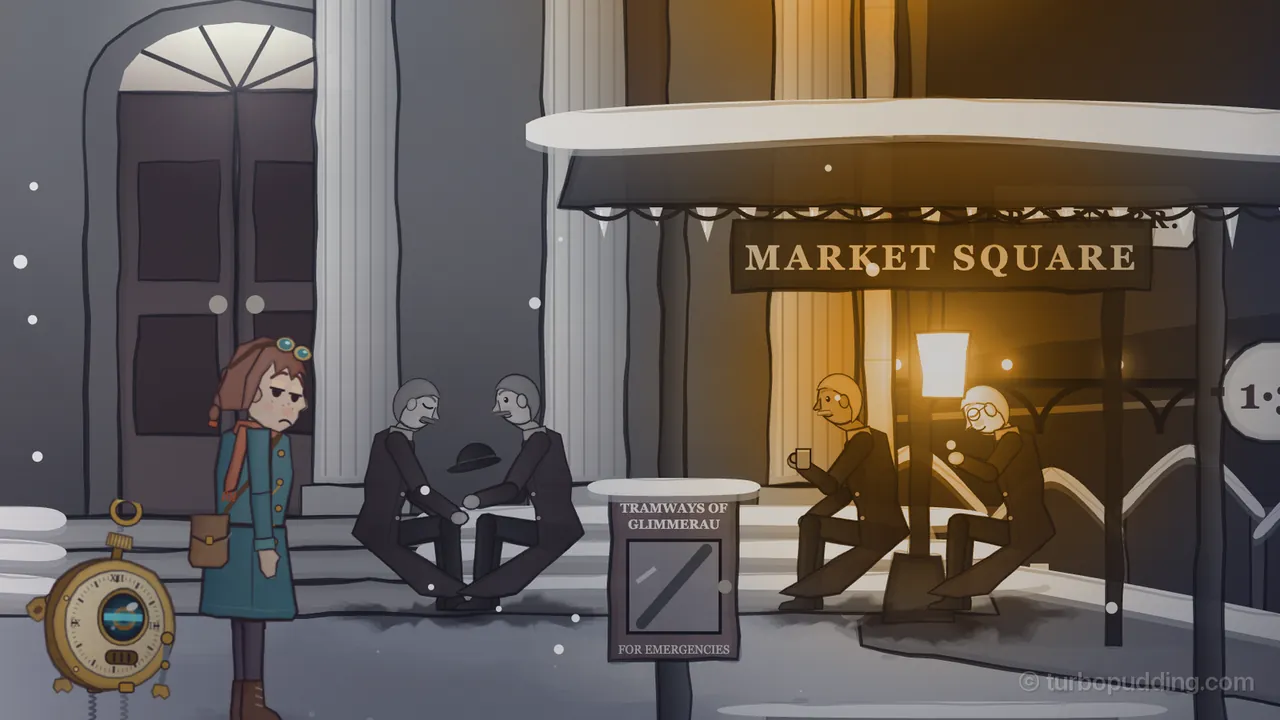
So when Mira reaches the market square at 11:47, five Masters are sitting on the Guild Hall steps, “like men who just ran up a mountain.” Tik takes one look and sums them up: “Sparks... small. Very small.” Four of them are at the top of this post, by the tram stop. The fifth sits a little way off, against a lamp post of his own.
Master Anselm Holt, the one who climbs
This year, in Mira’s words, it’s “Grandpa’s turn.” Her grandfather is Anselm Holt, and the certificate over the workshop door says so: “Guild of Clockmakers — Anselm Holt, Master.” Barnaby, the Guild’s brass doorkeeper, saw him go: “Master Holt went up at half past eleven. Tower key, good coat, a thermos of tea.” The last line in the Guild’s visitors’ book is in his hand, “A. Holt. Tower. 11.30.”, and nothing comes after it.
Grandpa isn’t home when the clocks stop, so you get to know him the way Mira does, through the things he leaves behind. His bench has “forty years of scratches,” and she knows every one. He has rules for everything: “Warm hands, warm heart” at the stove, and a key in its place is “a promise kept.” Mira calls his rules “mostly sensible and entirely unbreakable.” Tea is “Grandpa’s answer to everything except the Guild.” And when the Kessel twins “improve” the toys Herr Kessel makes, Grandpa is the one who fixes them.
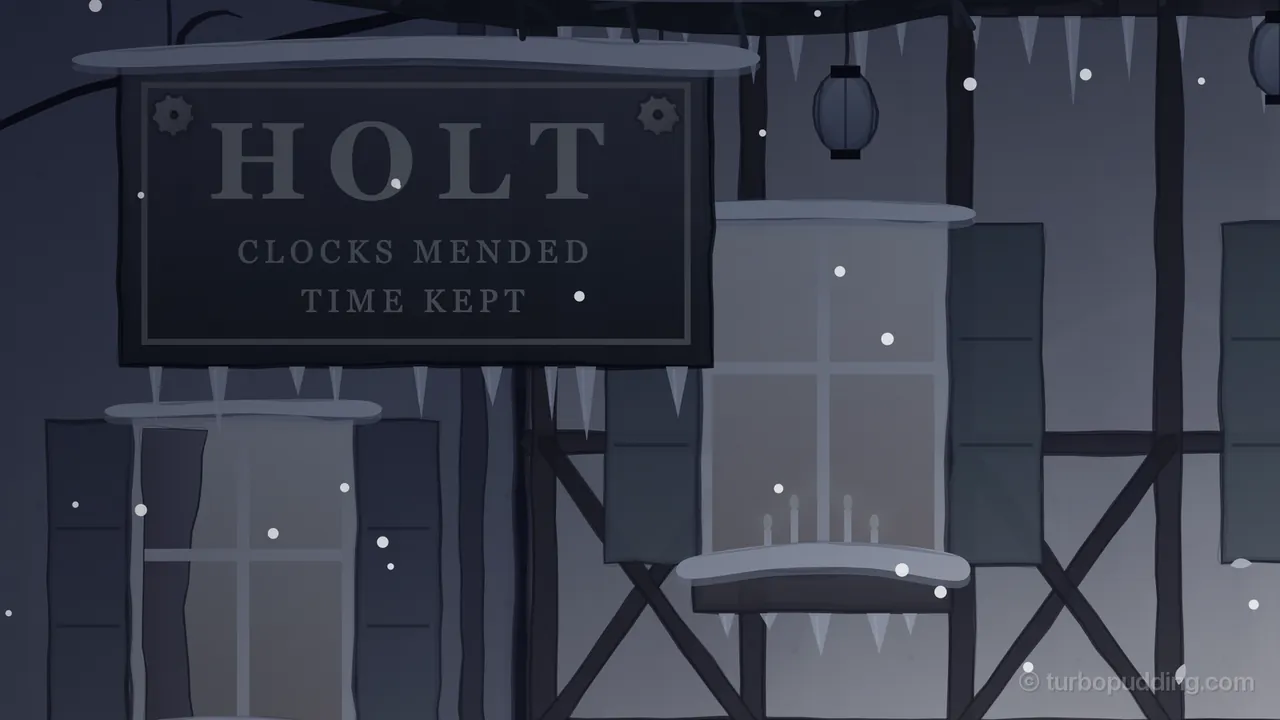
Above the Holt doorstep on Clockmaker’s Lane hangs his shop sign: “Holt. Clocks mended, time kept.” Grandpa repaints the letters every spring, because, as he puts it, “gold paint is a promise to the street.” In the stopped minute, the letters look as gray as everything else.
Brandl, Kirsch, the Obers and Old Pell
“Master Brandl. Master Kirsch. Both Obers. Old Pell.” Mira knows them all by sight. Master Brandl runs Brandl and Sons across the lane, watches and repairs since 1868. His notice in the Courier promises “Clocks wound, cleaned and forgiven.” On the steps he sits in the lamplight with his eyes open, still holding his mug.
Next to him, Master Kirsch has slumped forward, fast asleep with his round spectacles still on. The two Obers sit face to face with matching mustaches and a bowler hat between them, one awake, one dozing. And Old Pell, white-haired and white-bearded, has fallen asleep against a lamp post in his best robe. Mira’s verdict: “He’d hate to know.”
There isn’t much she can do for them. Try to wake one, and she already knows how that goes: “You can’t shake a spent man awake. I tried with Grandpa after Guild dinners.” Offer them a coin, and she answers for them: “Ten hellers won’t buy back a spark.” (Hellers are the town’s small change.) What they really need, she decides, is sleep and soup, and she has neither.
The seventh Master
Five on the steps and Grandpa up the tower make six. Mira can do the rest of the math: “Six from seven... The Provost. Who’s always late.”
Provost Aldous Crane is the head of the Guild, and he’s the one asking the town, in the Courier, to keep off the tower steps and to “trust the Guild, as Glimmerau always has.” Mira has a story about him, too. “Only Masters carry tower keys,” she explains, and then adds what Grandpa told her: the Provost keeps the spare under his pillow. Where the Provost is at 11:47 is something to find out for yourself.
Masters on the wall
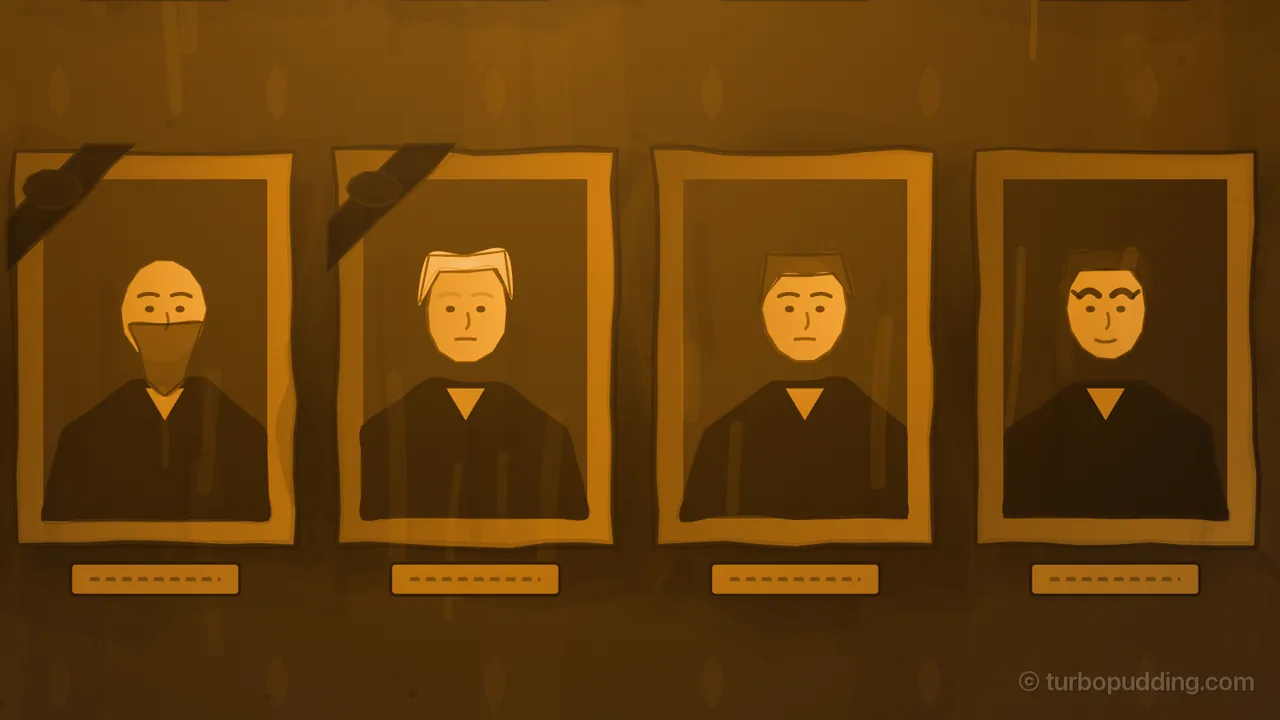
Inside the Guild Hall, the Masters who came before hang in gilt frames: “Masters in two rows, and on up the stairs.” Some frames carry a band of black crêpe, a mourning ribbon, for “the ones who’ve gone.”
One portrait in the lower row is Grandpa: “Thirty years younger, same eyebrows. He looks like he’s about to tell the painter off.” At the end of the row hangs Master Fenwick, in crêpe. He died last winter. Grandpa didn’t go to the funeral, because, as Mira reports, he’d “said it all to his face.”
The very first of them doesn’t hang inside at all. She stands in bronze in the middle of the square: Hesper Lind, clockmaker and founder of the Guild, who set the Great Clock going in 1427.
Tomorrow Ago is free to play in your browser at tomorrowago.com. More about the game is on its Tomorrow Ago page.