Turbo Pudding
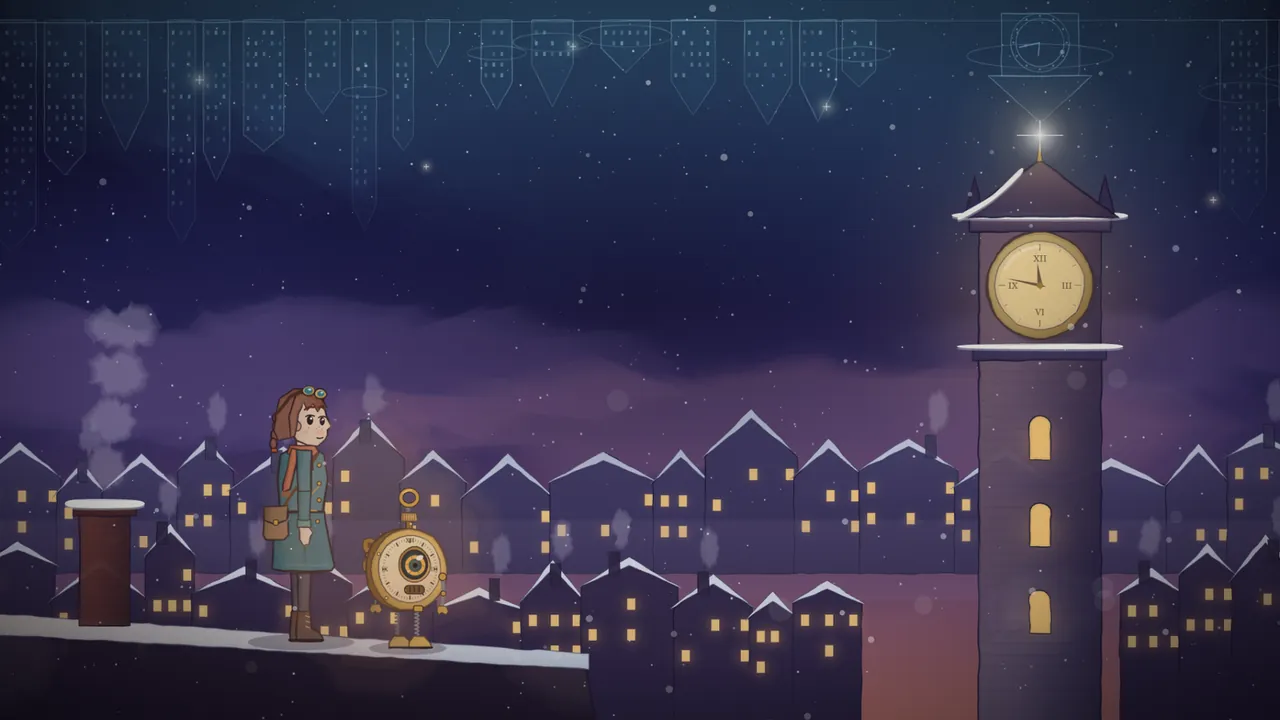
Glimmerau, 21 December 1927. It’s Winding Night, the whole town is out in the snow, and at 11:47 every clock stops. Everyone stays exactly where they were, in the middle of whatever they were doing, and only Mira and Tik keep moving. This Sunday, we open the sketchbook on everybody else: the townsfolk who stopped mid-step.
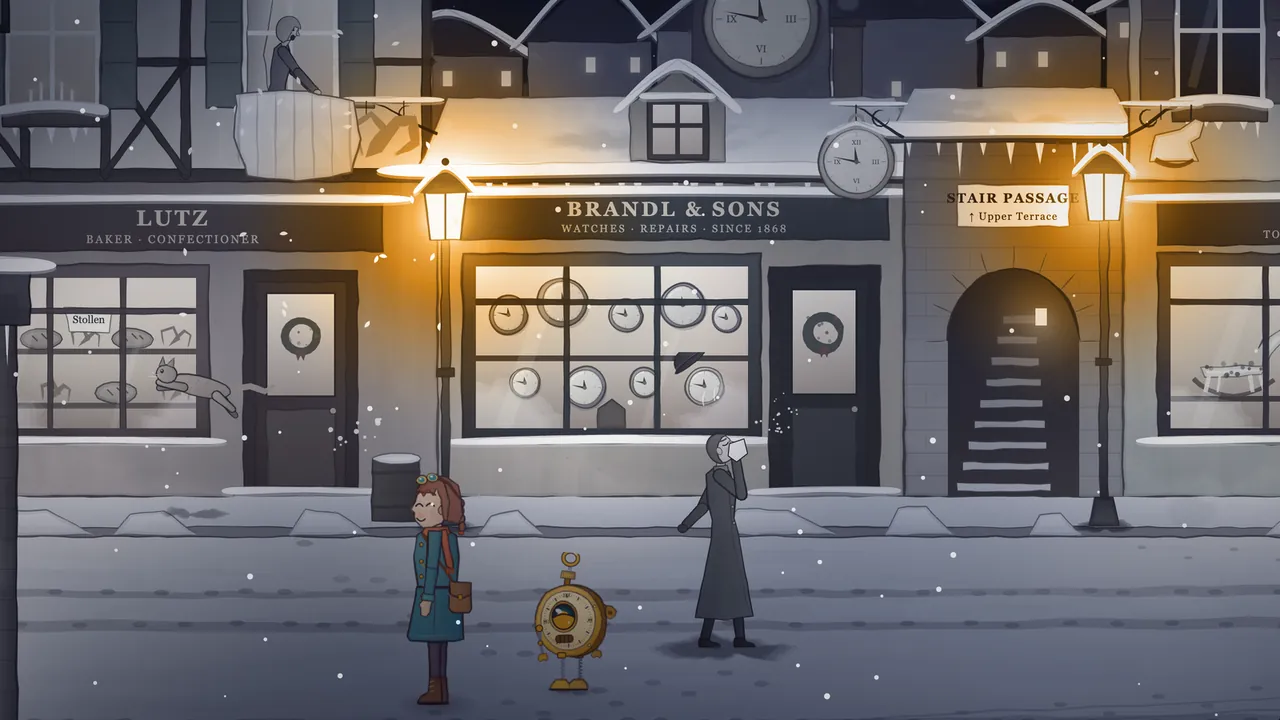
The picture at the top is Clockmaker’s Lane at 11:47. Upstairs, Frau Lutz leans out of her window shaking out her feather bed, the way she does every Winding Night “for luck.” Below her, Mitzi, the baker’s cat, hangs halfway between the barrel and the windowsill. And in front of Brandl’s window, Doktor Fogel has reached the very top of a sneeze. His bowler is still in the air.
Props, not actors
Mira and Tik are actors. They walk, turn around, talk and change their faces. The people of Glimmerau never move at all, so in the game each of them is a prop, like a lamp post or a shop sign: one painted picture, made once when the scene loads.
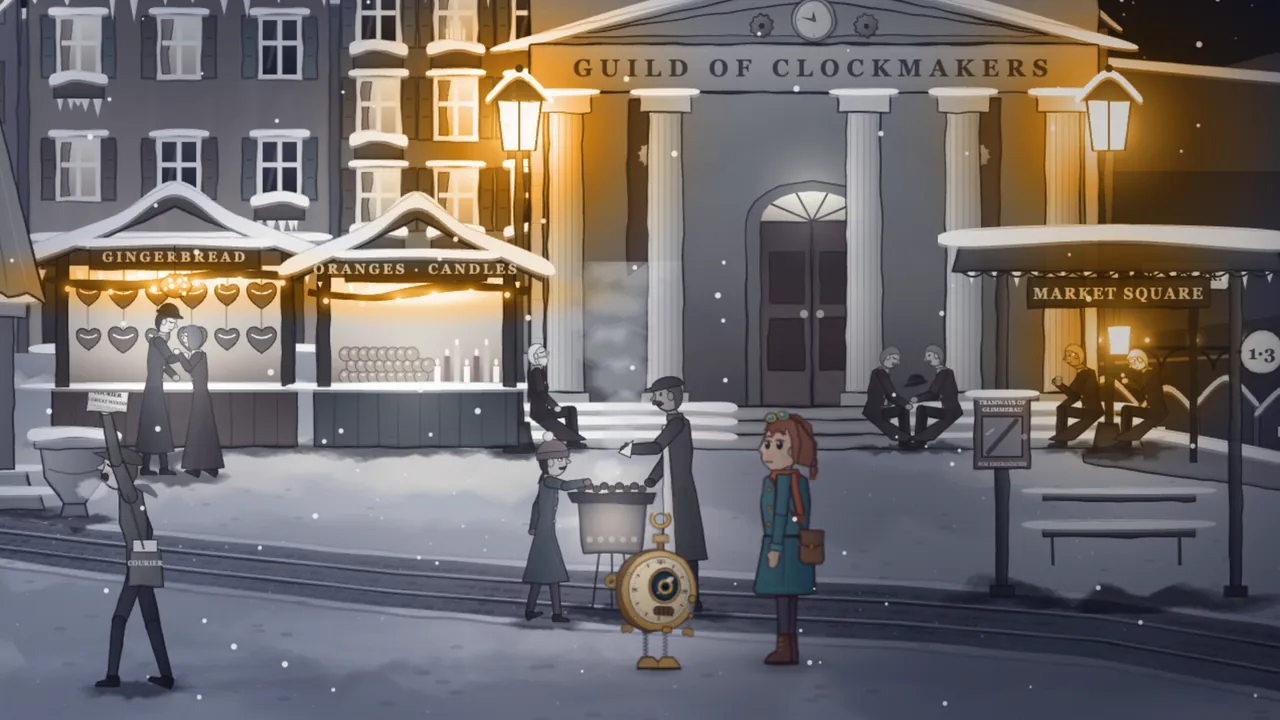
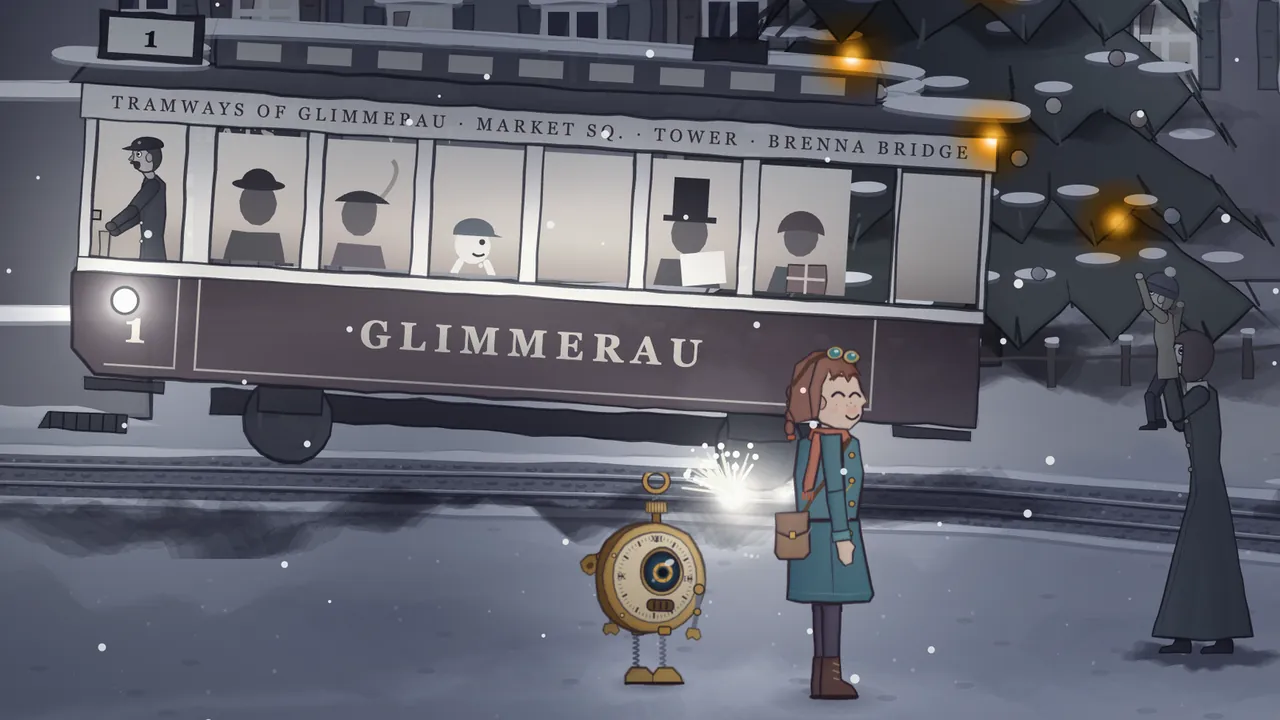
That changed how we drew them. A townsperson only has to look right in a single moment, the one they got stuck in, so all the work goes into that moment. On Market Square, tram No. 1 has stopped mid-lurch, its front wheels a hand’s width above the rail and a fan of sparks hanging under the rear ones. Next to it, a mother holds her little boy up to see the star. In Mira’s words, “His mouth’s wide open, like he wants to eat it.” Tik offers to lift Mira too, and gets a kind answer: “…You’re about knee-high, Tik. But thank you.”
A pose is a list of points
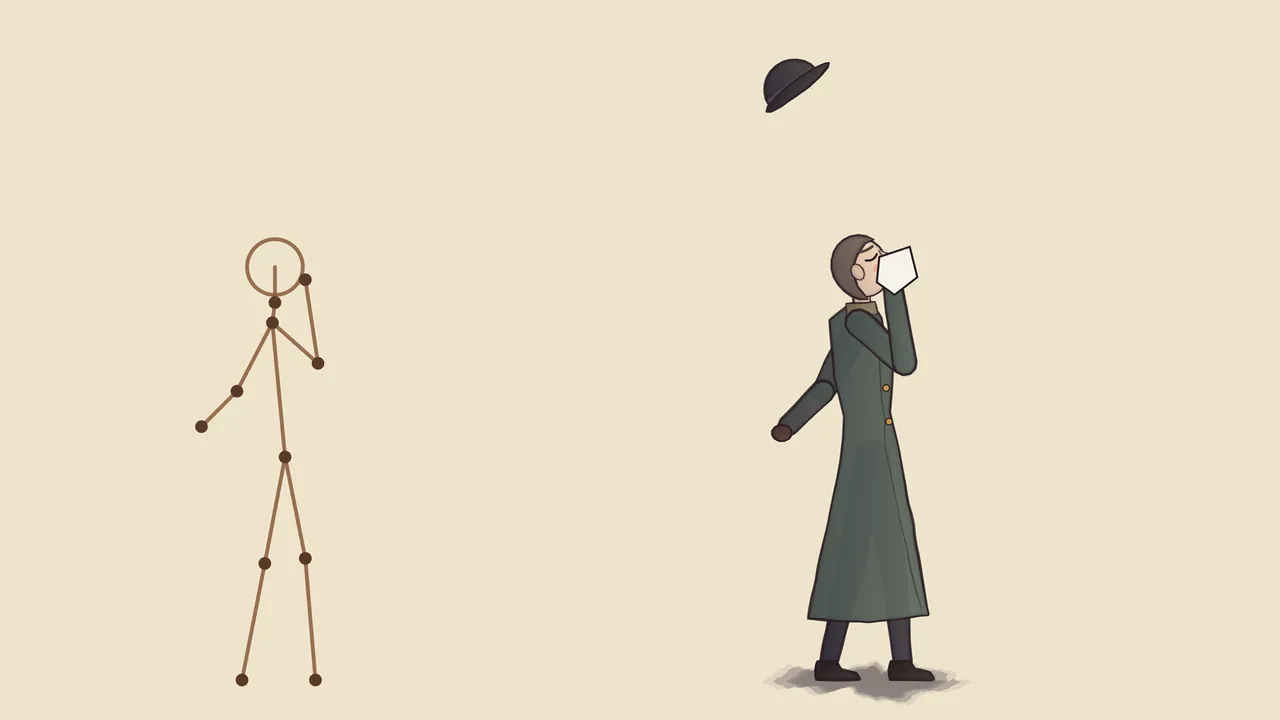
Every townsperson starts as a sketch of dots. A figure stands in its own little space with its feet at zero, facing right. A grown-up is 360 units tall, and Mira is 338. A pose is twelve points: head, neck, shoulders, hips, an elbow and a hand for each arm, and a knee and a foot for each leg. Add the tilt of the head and, when a heel is off the ground, the angle of the foot, and that’s the whole pose. Arms and legs are tapered shapes drawn between the dots. Someone facing left is the same figure, flipped.
Doktor Fogel’s sneeze, for example, is his head thrown back, one hand up at his nose with a handkerchief and the other arm flung out behind him. Mira has thought about helping: “I could wipe his nose. I will not wipe his nose.”
Dressing a figure
Then the costume goes on, in the same order every time: the back arm, the back leg, the front leg, the coat, the head and, last, the front arm. The coat is one shape that follows the body and the legs, cut at the hip, the knee, the calf or the ankle. Longer coats get a front edge and three brass buttons.
Every piece is lit from the front and above and shaded at the back, the same way Mira is painted, and the outline is a wobbly sepia ink, never black. Faces come from a short list too: eyes open, shut or wide, a mouth closed, open or grinning, and a moustache, a beard or spectacles for whoever needs them. Every face has a frost-pink cheek, and the children’s are pinker. Children also get bigger heads. Then a hat: a bowler, a top hat, a cap, a kerchief or a beanie with a pompom.
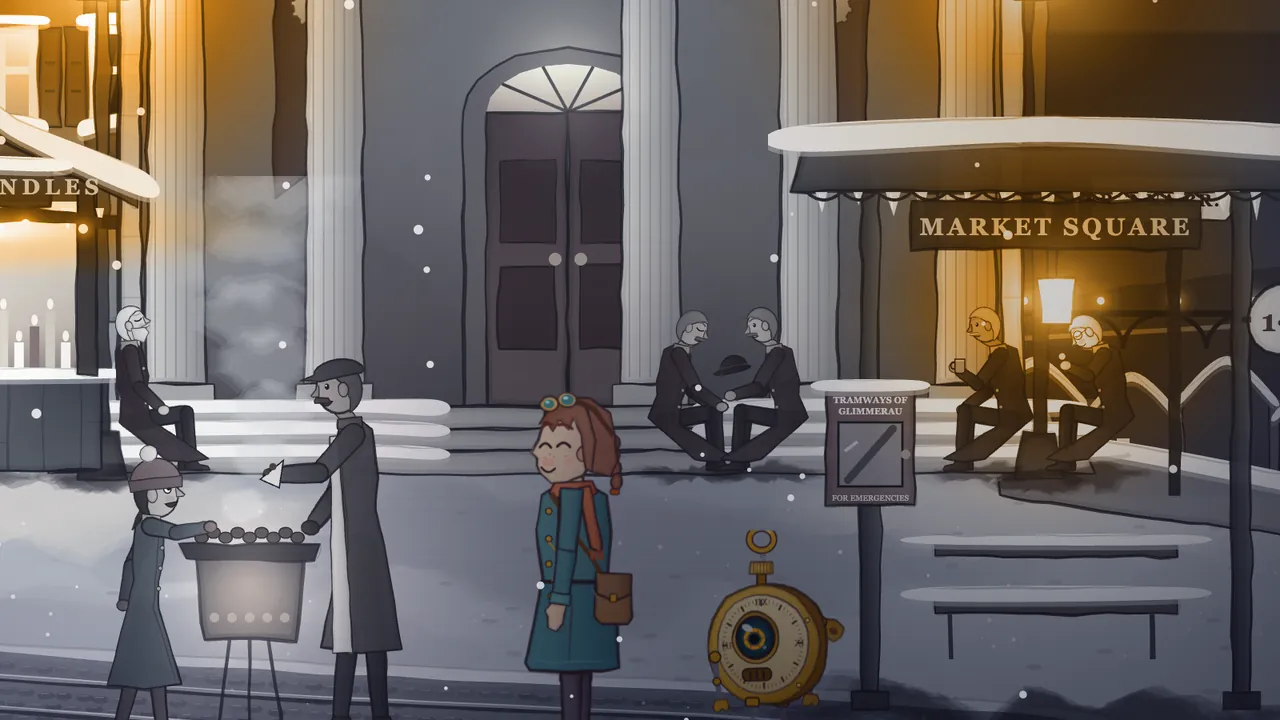
The chestnut man on the square has a cap, a moustache, gloves, an apron over his coat and a grin. “He’s sold chestnuts on this corner since before Grandpa had a beard.” The girl reaching for his cone has a beanie with a pompom, a braid and wide eyes. Mira’s guess about her: “When time starts, she’ll burn her fingers and not care one bit.”
Caught in the middle of something
A stopped town is only fun if you can tell what everyone was doing a second ago, so each figure gets a few clues. A scarf’s loose end flies out behind, frozen mid-flutter. The newsboy’s breath hangs in front of his mouth as a little cloud. Felix Kessel’s back foot is up on its toe because he has just thrown, while his twin, Greta, ducks with both arms over her head. At the gingerbread stall, a couple lean in under the mistletoe with their eyes closed.
Some clues aren’t people at all: a bowler on its own, or a cat drawn in mid-leap, body stretched, front paws reaching, tail streaming. That one is Mitzi, and Mira won’t touch her: “If I move her an inch she’ll miss, and she will never forgive me.”
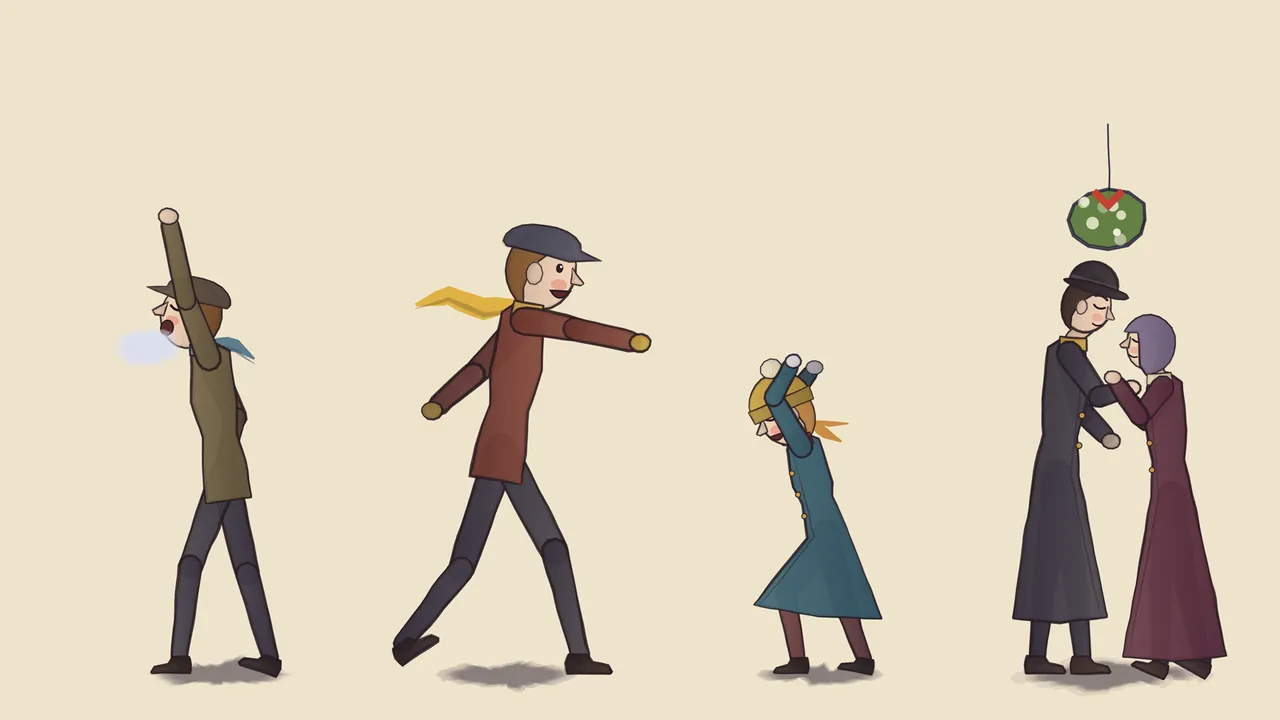
Tik sums up the couple in two words: “Stuck. Almost.” Mira has a kinder way of putting it: “Almost is a lovely place to be stuck, Tik.”
Walk among them
Tomorrow Ago is free to play in your browser at tomorrowago.com. More about the game is on its Tomorrow Ago page.