Turbo Pudding
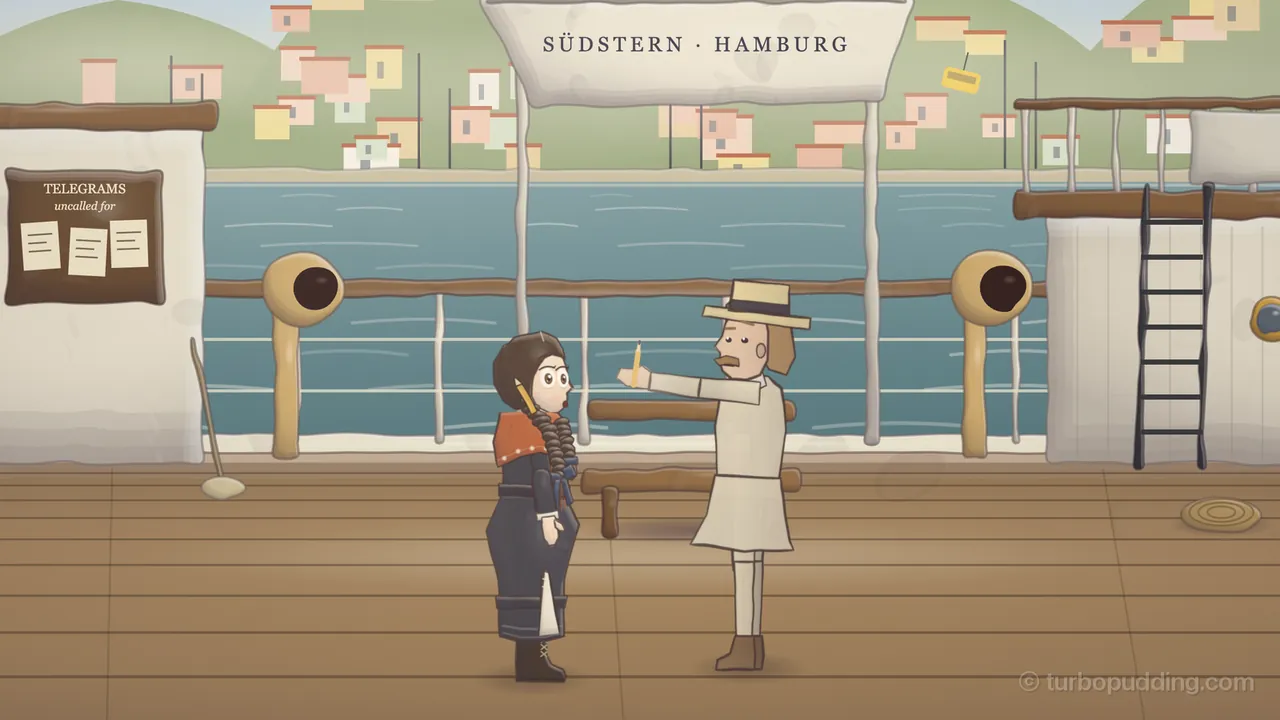
Fernevale follows Daina Ozola, a seventeen-year-old from Riga who draws forests nobody has ever seen. In 1911, her road runs from a sanatorium in Surrey all the way to Brazil, and chapter 7, Crossing the Line, puts her on a steamer called the Südstern. She travels third class, on the stern, among ropes, ventilators, benches and a great many bundles.
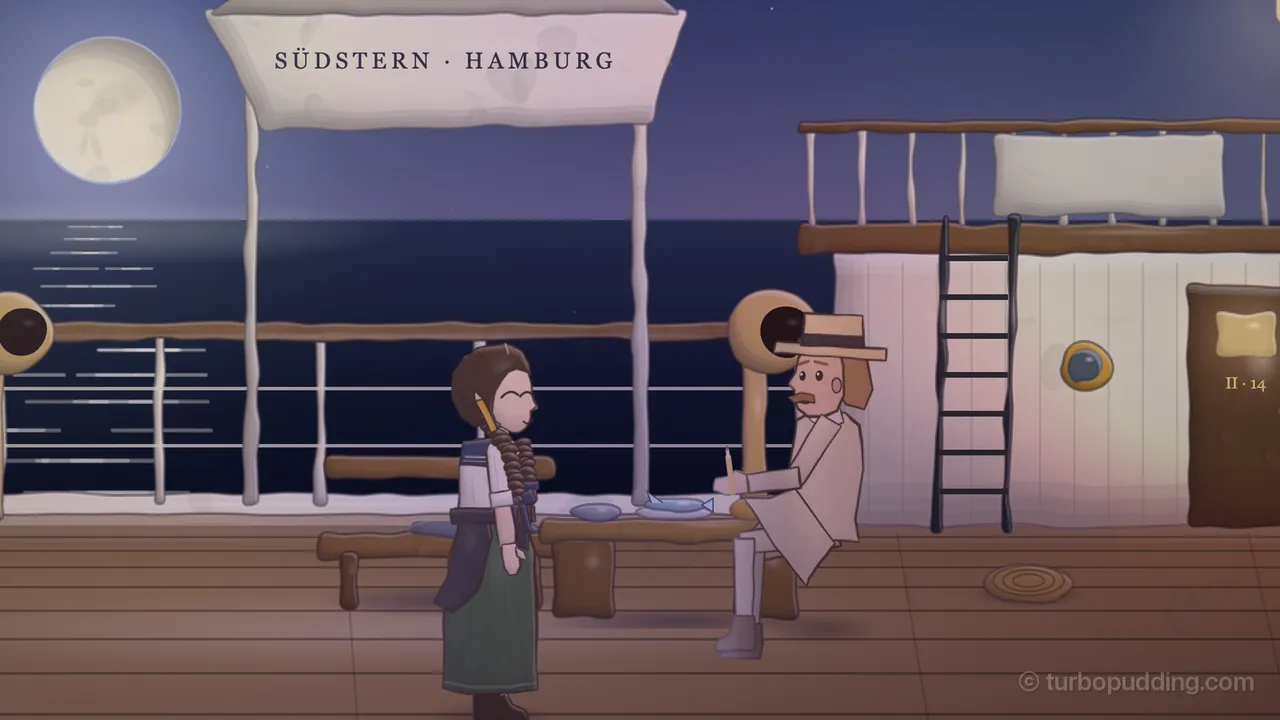
This Monday, meet the people she shares that deck with. At the top of this post, the ship lies off Lisbon, “yellow trams climbing hills like goats,” and a stranger in a straw hat is sizing Daina up with a pencil.
Mr. Grayle, who measures everything
Mr. Grayle is a tall, thin man in a linen suit and a boater. He walks along the rail counting his steps, and Daina’s verdict on that walk is pure Daina: “He walks as if the deck owed him yards.”
He doesn’t say hello. He holds a pencil out at arm’s length, shuts one eye and squints at her, the way you’d size up a tree. “Five foot four and a quarter. You’d make a fair sapling.” Only then does he tip his hat and give his name. He’s a surveyor for a company that deals in timber and settlers in the Serra, the mountains of southern Brazil. (Serra is Portuguese for a mountain range.)
Ask him what he surveys, and he says valleys: “Empty ones. Brazil’s full of them.” Ask whether maps ever lie, and you get his whole outlook in three short sentences: “Maps don’t lie, miss. People do. Rivers occasionally.”
He doesn’t stop measuring at supper, either. On December 5, the night of the full moon, he sits at a table on the stern with his plate. A flying fish leaps the rail and lands on it with a slap. Mr. Grayle doesn’t even jump. He measures it: “Nine inches. Volunteer.”
Pfeil, the purser
A purser keeps a ship’s paperwork, and on the Südstern that’s Pfeil: an older man with white hair, a dark uniform with brass buttons, a peaked cap and pince-nez on a cord. He goes everywhere behind an enormous green ledger, held flat in front of him like a tray. Daina’s take: “He carries it like a pudding.” Look at him again later, and she has found his other habit: “Three buttons, three wrong holes. Every day.”
Off Lisbon, his problem is the mail. “Telegrams, telegrams,” he grumbles. “Lisbon sends paper like a cow sends milk.” Anything nobody collects goes up on a board by his door, under a sign that reads TELEGRAMS uncalled for.
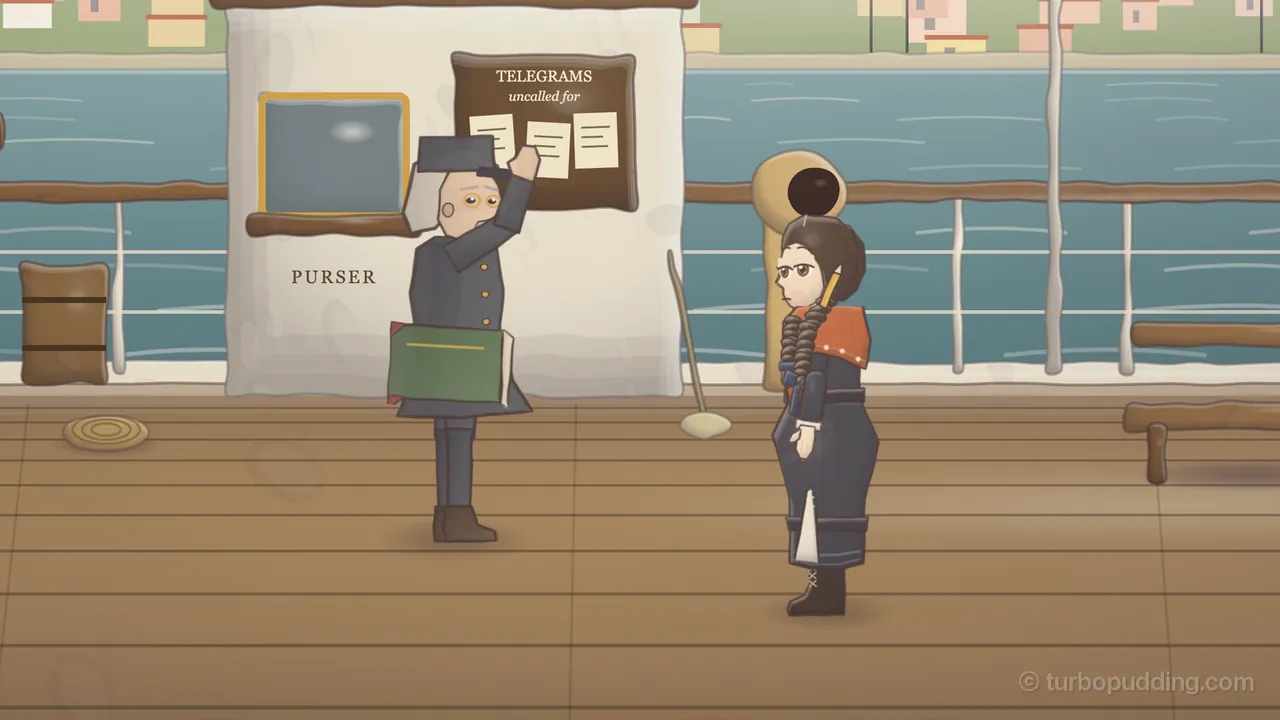
Then he reads out a name from his passenger list, and the whole stern looks round for its owner. So does Daina, politely, along with everybody else. “Poor woman. She must be deaf,” she thinks. Then: “Oh.” She came aboard under a borrowed name, and Pfeil has seen it all before: “Nobody answers to their own name on this ship.”
Kuhn, the second mate
Kuhn is the Südstern’s second mate, a bearded officer in a dark coat with brass buttons and a peaked cap. You meet him on December 3, at two in the morning. It’s too hot to sleep below, so Daina comes up on deck, and the southern sky is full of strangers: “Stars I don’t know. Like a book in Portuguese.”
Kuhn is up on the bridge wing, holding a rolled-up star atlas to his eye as if it were a telescope. Daina’s summary: “He reads the sky through a book.” He’s friendly about the late hour. “Can’t sleep, Fräulein?” he asks. Fräulein is German for “miss,” and that’s what he calls her. He knows this sky well and is glad to point things out. What he points at is for you to find in the game.
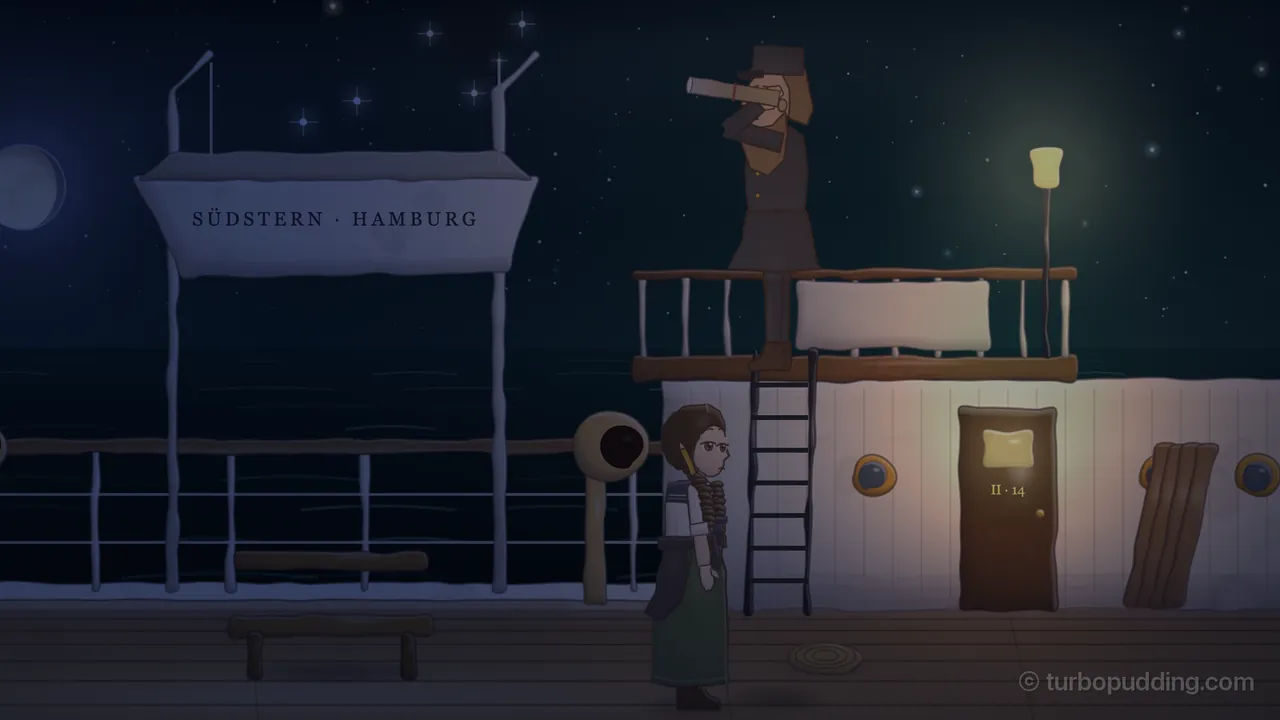
He also has views on noise. Hum Daina’s tune on deck that night, and the answer comes from above: “Hum quieter, Fräulein. The captain sleeps like a mine.”
Forty languages on the stern
The rest of third class sits on its luggage: an old woman in a black kerchief, a man in a cap on a tin trunk, a young mother with a baby in her shawl, a boy on the deck and a big man on a cask. Daina sums them up in one line: “Bundles, babies, forty languages. All going to Brazil.”
Not everyone aboard has a ticket. By day, the ship’s cat peeks over the water cask by the galley. By night, a rat does the same, and Daina approves: “A ship’s rat, checking the galley’s locks. Same job as Pudding.” Pudding is her hedgehog, who rides along in a hatbox. Even the lifeboat gets a review: “Room for forty. Seats for none.”
Chapter 7 and everyone on the Südstern are part of the full game. The prologue and chapters 1–2 of Fernevale are free to play in your browser at fernevale.com. The full game is $9.99, paid once. More about the game is on its Fernevale page.